

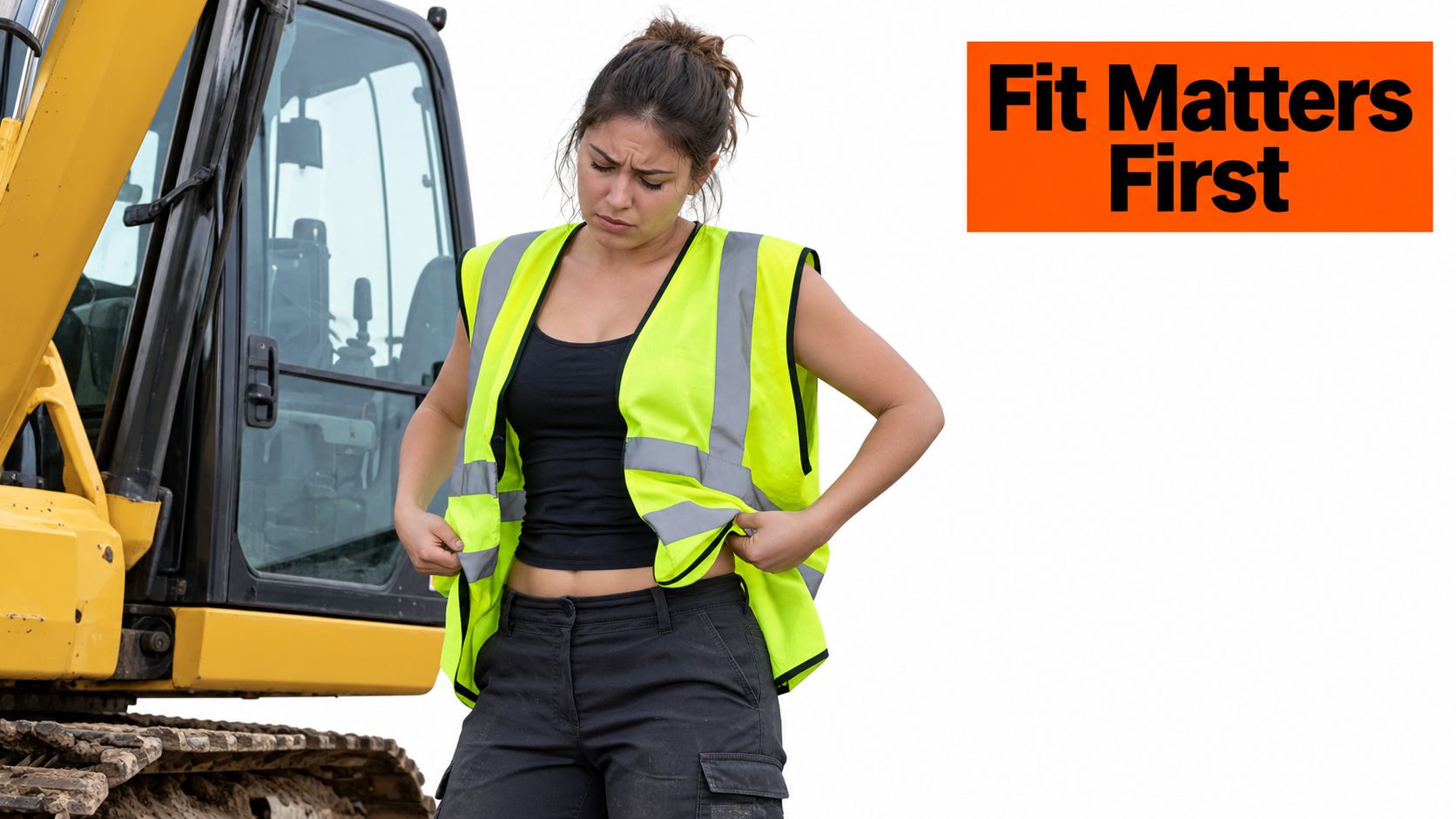
You can spot the problem before the shift even starts. The vest looks fine on the hanger, but once a woman pulls it over base layers, the hem rides up, the shoulders pull tight, and the reflective tape sits where it won't do its job when she reaches for a tag line or climbs into a cab.
That's the gap with women's high visibility clothing on real worksites. A garment can look compliant on paper and still fail in motion, which is exactly where crane crews, riggers, shutdown teams and mining personnel spend their time. The safest option is the one that keeps its visible coverage, stays put under movement, and fits the body wearing it, not the pattern it was copied from.
Table of Contents
- Why Women Need Different Hi-Vis Solutions
- Understanding AS 4602.1 Compliance Requirements
- How Reflective Band Placement Affects Visibility
- Comparing Unisex Versus Women-Specific Hi-Vis
- The Movement-Based Fit Checklist
- Procurement Guidance for Crew Orders
- Building Safer and More Inclusive Crews
Why Women Need Different Hi-Vis Solutions
A female crane operator can pull on a site vest that was clearly sized around a male block, then spend the first ten minutes of the shift tugging at it every time she reaches overhead. The shoulders feel wrong, the body length is off, and the reflective bands start creeping into the wrong place as soon as she bends, twists or climbs. That's not a comfort complaint, it's a visibility problem and a dignity problem at the same time.
The workforce reality is simple. Women represented 13.2 per cent of the construction workforce in the Australian Government's 2024 Status of Women Report Card, and a Western Australian Government analysis describes construction as Australia's most male-dominated industry, with men accounting for 6 out of every 7 employees. In mining, women comprised 22 per cent of the mining workforce, and full-time mining employment among women rose from approximately 8,700 in August 2002 to 45,000 in August 2022 (Australian Government, 2024 Status of Women Report Card).
That matters because a smaller version of a men's garment doesn't automatically solve the fit problem. Torso length, bust-to-waist proportions and sleeve movement all change how a vest or shirt sits during real work. On a site, a garment that rides up or twists out of position stops being a piece of PPE and becomes gear you keep adjusting instead of working in.
Practical rule: if a hi-vis garment needs constant tugging, it's already failing the wearer.
A women-specific cut only earns its place if it keeps the certified visible surface where it belongs. For crane, rigging and mining roles, that means the clothing has to work while the body is climbing, crouching, reaching and loading tools, not just while standing still for a fitting. Outrig Supply Co's women's work shirts guide sits in that wider conversation about fit, movement and site use.
Understanding AS 4602.1 Compliance Requirements
A compliant hi-vis garment is not a branding choice. In high-risk work, AS 4602.1:2024 sets the visibility requirements for garments worn around moving traffic, mobile plant and equipment, which is exactly the setting on crane pads, rigging decks and mine sites. If a crew cannot be seen clearly by plant operators or load handlers, the garment has failed its job before the shift starts.
What compliance actually means
Compliance means the finished garment delivers the level of conspicuity the work requires. That can mean daytime fluorescent visibility, night-time retroreflective visibility, or both, depending on the classification and intended use. For crews working near vehicles, lifts or plant, hi-vis is part of hazard control, not a uniform preference.
The standard has also changed over time, which matters when buyers rely on old assumptions. AS/NZS 4602.1:2011 replaced AS/NZS 4602:1999 and tightened requirements for the amount of background high-visibility material used in garments for high-risk applications. Its successor, AS 4602.1:2024, is listed as the third edition and excludes fire-service clothing, keeping the scope on occupational garments for high-risk work.
Procurement teams should verify the whole garment, not just the cloth or tape. A women's cut can still miss the mark if the finished piece reduces visible area, shifts reflective elements, or rides out of position once it is worn with base layers, harnesses or tools. A sample that passes as fabric can still fail as PPE on a live site.
For background on garment types and classifications, see Outrig Supply Co's guide to hi-vis shirts.
What to verify before you buy
- Standard marking: Check that the finished garment is sold as compliant with AS 4602.1:2024 for the intended use.
- Garment-level certification: Confirm the certification applies to the whole product, not just the cloth or tape.
- Wear conditions: Check how it performs over base layers, under harnesses and while moving.
- Task context: Match the garment to the actual risk, especially where vehicles, lifting operations or mobile plant are present.
Safe Work Australia identifies high-visibility clothing as a control for workers and pedestrians exposed to vehicles and powered mobile plant. That makes the spec a safety decision, not a buying preference.
How Reflective Band Placement Affects Visibility
A hi-vis garment can look right on a peg and still work poorly on a person. The issue is usually placement, not just colour. Technical high-visibility specifications derived from the Australian standard require retroreflective strips at least 50 mm wide, with torso hoops that substantially encircle the body, plus front and rear braces or cross configurations meeting at the shoulder and waist (NZTA specification for high-visibility safety garments).
Where fit changes the safety outcome
Women's patterning changes how those bands sit. A shorter torso can pull a hoop upward. A different bust-to-waist shape can make the front gap, fold under the bust or sit unevenly after the first few bends of the shift. Once outer layers come over the top, the visible area can shrink again. The garment may still look hi-vis from a distance, but the actual reflective geometry is no longer where the standard expects it to be.
That's why front, rear and side views matter during selection. Arms need to go up. The wearer needs to crouch. The garment should also be checked while seated in a vehicle or operator's cabin, because lots of work happens there and reflective placement can change once the body angle changes. Outrig Supply Co's reflective tape guide sits neatly alongside that practical test because the tape only helps if it stays visible in use.
If the tape disappears under a harness, folds under a bust line or rides above the torso when the worker lifts her arms, don't call it fit.
What works and what doesn't
A good women's cut preserves the band width, keeps the hoops continuous and respects the body shape it's made for. A bad one just scales down the chest and leaves the reflective map in the wrong place. That's the hidden difference between a garment that looks compliant in a warehouse and one that keeps doing its job under load, in a cabin or beside moving plant.
For crews in crane, rigging and mining roles, “women's sizing” stops being a comfort label and becomes a visibility-engineering issue. The garment has to hold its geometry while the wearer works. If it can't do that, it isn't giving you the protection you thought you bought.
Comparing Unisex Versus Women-Specific Hi-Vis
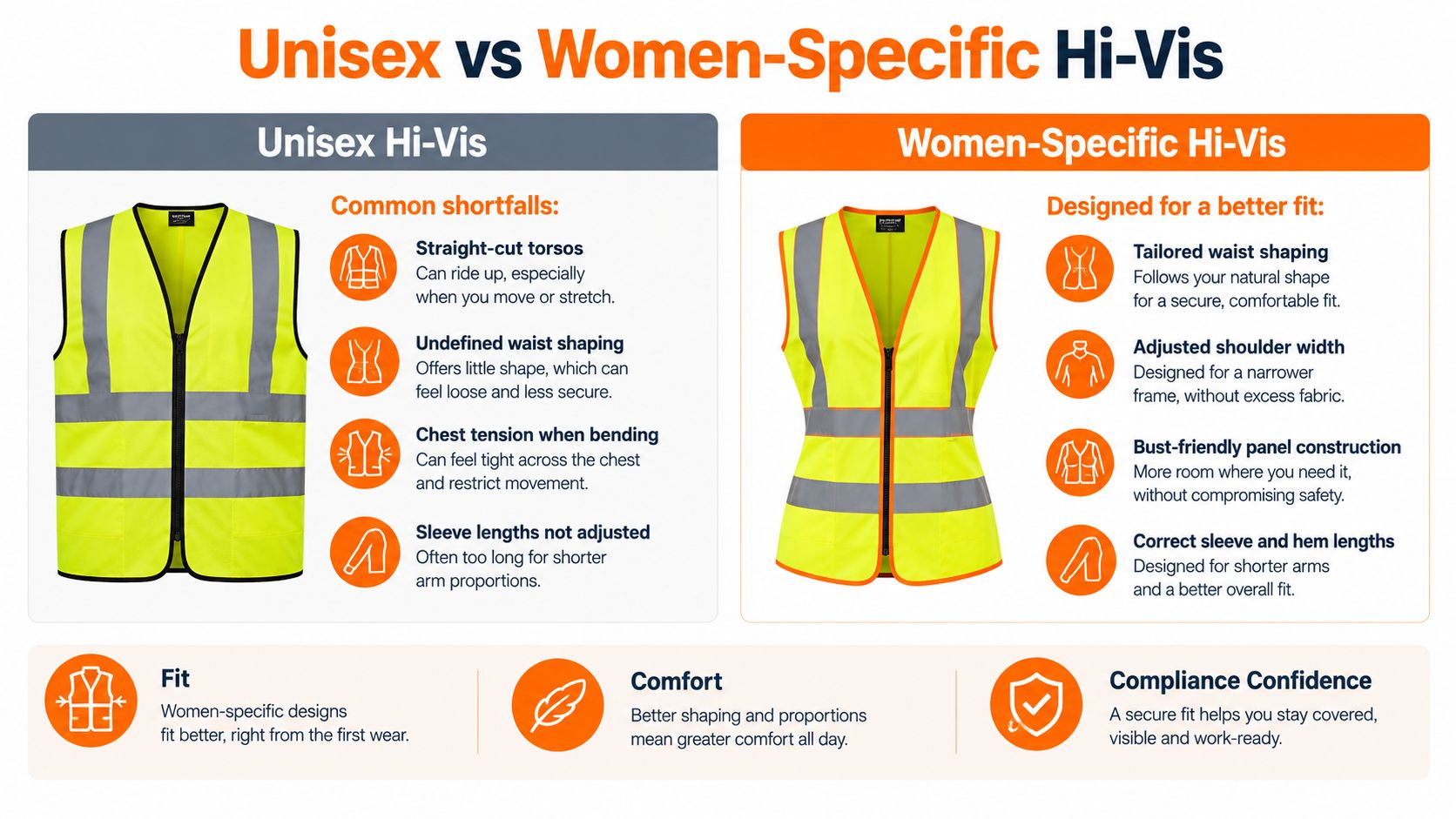
Unisex hi-vis is often the default because it's easy to buy in bulk. The problem shows up on body shapes that don't match the straight-cut block, especially when the shift involves reaching, squatting, climbing or wearing a harness. In practice, that's where fit complaints start and where the garment starts being altered, adjusted or left unzipped in ways that reduce how well it protects.
Where unisex usually falls short
Research on women in construction found low satisfaction across functional, expressive and aesthetic PPE attributes, and satisfaction was strongly associated with needing alterations or adjustments, inadequate PPE-use training and the perceived productivity effects of poor fit. In plain site language, if the garment needs changing before it feels workable, it's already costing time and confidence.
Unisex cuts often create the same set of problems:
- Straight torsos that ride up once the wearer bends or climbs.
- Loose shoulders that let the garment twist under load.
- Chest tension that makes closure awkward over layers.
- Poor length balance that doesn't respect shorter torso proportions.
Where women-specific sizing helps
Women-specific grading doesn't mean a different colour or softer fabric. It means the garment is shaped to the body so the hi-vis elements stay where they should be. That can improve wear-time, reduce constant adjustment and make it easier to keep reflective areas visible while the worker does the job.
The difference matters most in procurement. If a supplier only gives you the usual unisex ladder of sizes, you're still making female crew members adapt to the garment. If the supplier offers women's graded sizing, you've got a better chance of keeping the garment aligned with the body and the standard at the same time.
A quick comparison
| Criterion | Unisex sizing | Women-specific sizing |
|---|---|---|
| Overhead reach | More likely to ride up or twist | Better chance of staying aligned |
| Layering | Can bunch over shirts or under harnesses | Usually easier to balance across layers |
| Compliance confidence | Depends heavily on how the garment sits on the wearer | More likely to preserve intended coverage |
A practical option for site teams is to treat women's fit as part of the tender, not an afterthought. If a garment is only technically compliant on paper but fails when the wearer lifts, bends or straps into gear, it won't hold up in the field. The Outrig Supply Co Women's Crew Tee is one example of a relaxed-fit women's cut with a true-to-size note and garment measurements listed flat, which is the kind of transparency crew buyers should expect from workwear suppliers.
The Movement-Based Fit Checklist
The fastest way to judge women's hi-vis is to move in it before the bulk order lands. Standing in front of a mirror tells you almost nothing about whether the garment will keep its reflective geometry while you work. A proper check needs overhead reach, crouching, climbing posture, layered wear and enough time to see whether the garment settles or keeps shifting.
Check the garment the way the job will use it
- Overhead reach: Raise both arms and check whether the hem lifts so far that the visible area shrinks. If the bands move up sharply, the cut is wrong for the wearer.
- Crouch and bend: Squat, kneel and lean forward. Look for chest pull, gaping, coverage loss or fabric tension that could make the garment uncomfortable and distracting.
- Harness compatibility: Fit the hi-vis with fall-arrest gear or the harness the worker wears. If straps block reflective bands or force the garment into an odd position, that's a problem.
- Pocket and tool access: Reach for the items used on shift. If pockets disappear under a belt, harness or layer, the garment isn't practical.
- Seated posture: Sit in a ute, loader or crane cabin and check the front, side and back again. A garment that looks fine standing up can fold differently once the hips and torso change angle.
Read the warning signs
A good fit stays predictable. A bad fit keeps announcing itself every time the wearer moves.
The biggest red flags are simple. Reflective bands stop sitting level. The front closes under stress. The hem climbs too high. The wearer starts working around the clothing instead of in it. If any of that shows up during a test fit, don't assume it will improve after a few washes or a few shifts. It usually doesn't.
For shutdown crews and FIFO teams, this checklist is worth using before you commit to a full order. It catches problems that a sizing chart can't, especially when different body shapes need different proportions across torso, bust, sleeve and shoulder. That's where a good spec turns into a safe garment and a bad spec turns into expensive storage.
Procurement Guidance for Crew Orders
Site supervisors and buyers need a spec that removes guesswork. For women's hi-vis, the cleanest approach is to ask for an AS 4602.1:2024-compliant garment, documented garment-level certification, women's graded sizing, secure closure, and visibility that stays intact in the worker's normal operating posture. That keeps the conversation anchored to the actual job, not to vague claims about being “hi-vis”.
What to ask suppliers before a bulk order
| Criterion | What to verify | Why it matters |
|---|---|---|
| Standard compliance | The finished garment is certified to AS 4602.1:2024 | Confirms the garment is built for the intended risk |
| Garment-level proof | Certification covers the product, not just the fabric | Fit can change visibility after construction |
| Women's sizing | Graded sizes are offered for women, not just unisex downsizing | Reduces the chance of poor proportions |
| Movement fit | The garment has been worn, reached in, bent in and layered | Catch problems before they hit site |
| Closure and posture | The garment stays secure in the normal work position | Prevents shifting during actual tasks |
If you're buying for a shutdown crew, don't treat one sample size as proof. Bodies differ, layers differ and roles differ. A garment that fits one operator well can still fail a rigger or a supervisor once PPE, tool belts and movement are added. The order should reflect the crew, not the warehouse shelf.
Women's hi-vis also sits inside a larger workforce issue. As female participation grows in construction, mining, resources and site-based operations, reliable sizing and comfort stop being niche concerns. They become part of keeping people on site, keeping them safe and making sure they can do the work without fighting their clothing all day.
Building Safer and More Inclusive Crews
The woman who started the shift tugging at her vest shouldn't have to do that again tomorrow. When the garment is cut for the body, checked in motion and bought against the right standard, the whole job changes. She gets a clearer line of sight on the task, the crew gets a cleaner PPE setup, and the site loses one more avoidable distraction.
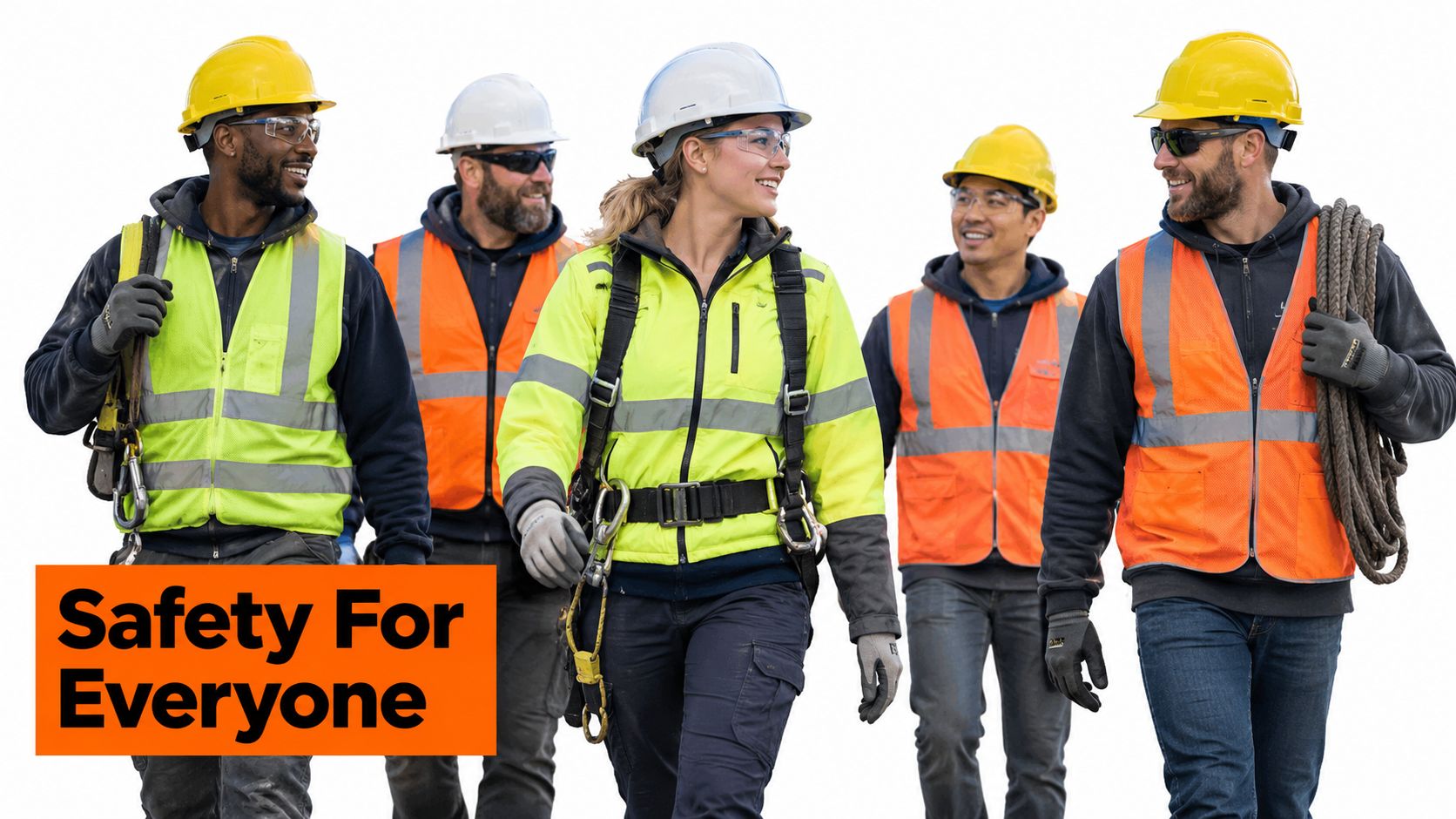
That matters because the workforce is changing in front of us. Women are already a visible part of construction and mining, and the rise from roughly 8,700 to 45,000 full-time women in mining between August 2002 and August 2022 shows how much bigger the user base has become. For supervisors, that means women's sizing can't be treated as an edge case or a token order line. It needs the same rigour you'd use for any other visibility-critical PPE.
What safer inclusion looks like on site
- The gear fits on the move. No constant tugging, twisting or re-fastening.
- The visibility stays where it should. Bands remain continuous and obvious in work posture.
- The crew looks like a crew. That matters for identity, confidence and consistency.
- The buyer checks before bulk ordering. One test fit can prevent a lot of avoidable waste.
If you're responsible for PPE on a crane crew, a rigging team or a shutdown roster, use the movement-based checklist before you approve the order. Treat women's sizing as a visibility-engineering issue, not a fashion add-on, and you'll end up with gear that people wear the way it was intended.
Outrig Supply Co offers worksite gear that speaks to crane, rigging and shutdown crews, including women's tees, headwear, accessories and crew-order options for teams. If you're sorting women's PPE-adjacent workwear and want clothing that fits the actual realities of site life, visit Outrig Supply Co and check what's available for your crew.