

You're probably looking at a stack of shirts that looked fine on paper and failed as soon as they hit site. The sleeves ride over the hands, the hem comes untucked on the first overhead lift, and the “women's” option turns out to be a men's shirt in a smaller size with no real room for bust, hip or shoulder movement. On a hot roster in the Pilbara, that's not a styling issue. It's a crew-readiness problem.
Table of Contents
- Why Women's Work Shirts in Australia Are a Real Site Problem
- The Participation Gap and What It Means for Shirt Design
- Getting the Fit Right on Australian Women's Shirt Blocks
- Fabric Choices for Hot, Dusty and High-Wear AU Sites
- Hi-Vis Compliance and Sun Protection in AU Work Shirts
- Matching Shirt Styles to FIFO, Shutdown and Warehouse Work
- Where to Buy Women's Work Shirts in Australia
- Buyer's Checklist and Common Questions Before You Order
Why Women's Work Shirts in Australia Are a Real Site Problem
A female rigger on a shutdown day needs a shirt that will not snag on harness webbing, trap heat, or expose skin when she reaches above shoulder height. On many sites, the workaround is still a men's 4XL or 5XL handed out as “close enough”, and that creates avoidable friction from the first toolbox talk to the last lift.
That shortcut fails for simple reasons. Sleeves drown the hands, the shoulder seam sits too far off the body, and the torso is cut for a different shape, so the shirt pulls across the chest or billows at the waist. Once a shirt rides up under a hi-vis vest or bunches under a harness, crews keep adjusting it all shift. That is the kind of low-level distraction that turns into discomfort, non-compliance, and replacement stock coming back off the same site before the season's out.
What breaks down on site
Poor fit is not just a comfort issue. It changes how women work through heat, climbing, lifting and repetitive reaching. If a garment is not built for female proportions, people improvise, and professionalism and PPE discipline start to slip.
In Australia, the women's workwear gap sits inside a broader participation problem. A 2019 regional NSW stakeholder report estimated women made up only about 1 to 3% of workers in manual trades nationally, and linked that shortage to a lack of suitable, affordable workwear options for women, including properly female-designed and sized garments and footwear (regional NSW stakeholder report). That is why buyers searching for women's work shirts in Australia keep running into the same problem, the market has been slow to treat fit as part of site participation, not a side preference.
Practical rule: if the shirt cannot handle a hot, dusty, repetitive-shift environment without constant adjustment, it is the wrong shirt, even if the fabric spec looks good on the hangtag.
The Participation Gap and What It Means for Shirt Design
A shirt can meet a catalogue specification and still fail the people expected to wear it. Australian survey findings show that 87% of female tradies struggled to find suitable protective clothing or workwear, 71% identified fit as the main problem, nearly half had worn casual or non-safety clothing on-site because suitable options were unavailable, and 40% felt less safe in poorly fitting garments (survey summary). The same summary reports that three in five women had worn workwear designed for men, while women were more likely than men to struggle to find garments made for their shape, at 37% versus 13%.
For a buyer, those findings point to a supply problem rather than a preference issue. Women may be a smaller part of a shutdown, roadwork or infrastructure crew, so suppliers often carry fewer sizes, limited colours and inconsistent replenishment. A women's shirt block that works on one site may still fail in a FIFO camp where garments are layered, or in a warehouse where staff repeat overhead reaching all shift.
| Buying issue | What to check | Practical sourcing implication |
|---|---|---|
| Size-curve coverage | Ask which women's sizes are held in stock and replenished | A narrow run creates gaps when a crew expands or replacements are needed |
| Block consistency | Request the garment's measurement chart and a sample before ordering | Crew members should not receive visibly different fits under the same size label |
| Site use | Match the shirt to heat, dust, abrasion, visibility and layering needs | Road crews, shutdown teams and warehouses may need different weights or constructions |
| Crew ordering | Confirm minimum quantities, repeat-order records and colour continuity | Aggregated orders improve consistency without commissioning custom patterns |
The practical response is to brief the supplier with the site context, not just “women's fit”. State whether the shirt will sit under a vest, work with a harness, handle wash-intensive shutdowns or protect staff in exposed roadwork areas. Confirm the size curve, fabric weight, UPF rating and hi-vis class before approving a bulk order.
Off-the-shelf women's shirts can work well when the block is properly graded and the supplier can repeat the same specification. That reduces trial orders, uneven replacements and the continued fallback to scaled-down men's garments.
Getting the Fit Right on Australian Women's Shirt Blocks
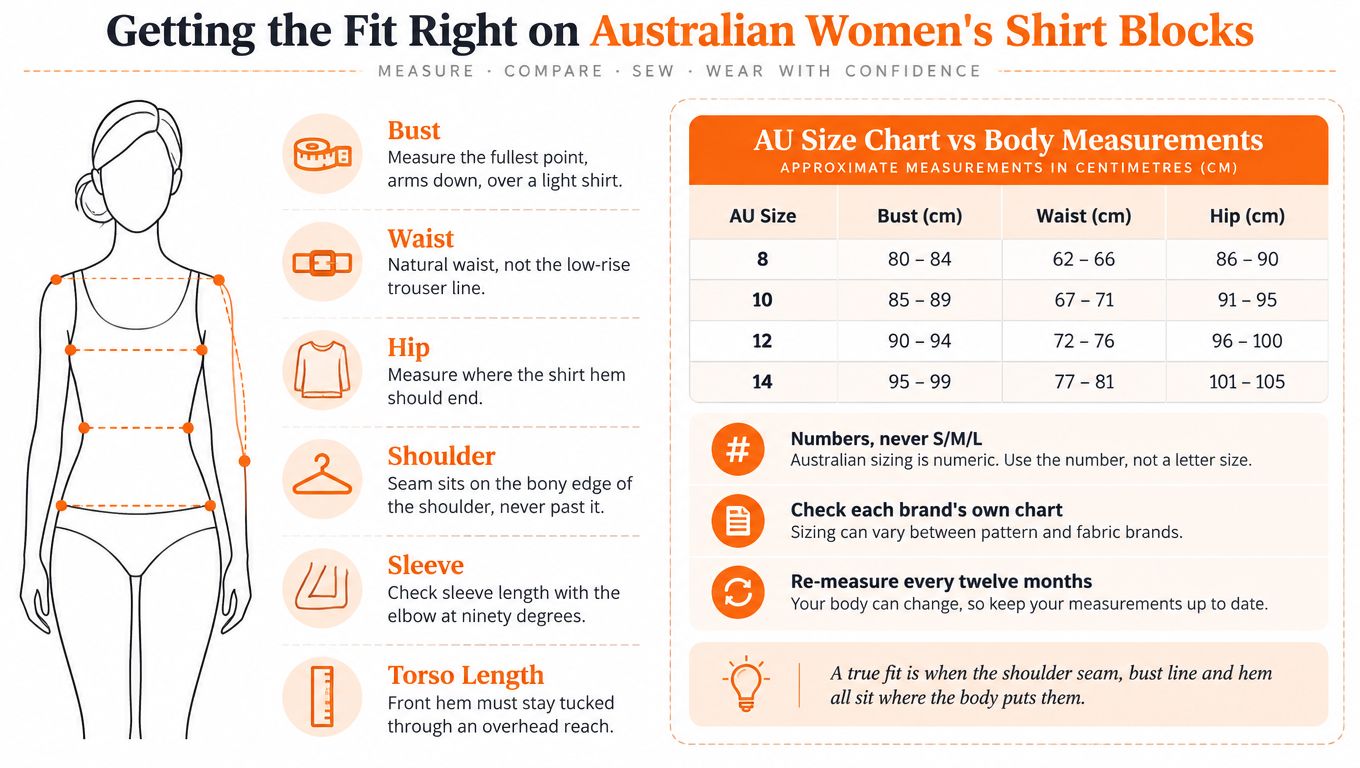
A true women's work shirt starts with the block, not the label. The shoulder seam should sit on the acromion, the torso should taper instead of just being shortened, and the hem should stay put when the wearer reaches, bends or climbs. A sized-down men's shirt usually misses at least one of those points, and once that happens the whole garment starts fighting the body instead of moving with it.
How to read a size chart properly
Take body measurements over light clothing, then compare them against the brand's chart, not a generic S/M/L. Measure the bust at the fullest point, waist at the natural waist, hip around the fullest hip, nape-to-waist for torso length, and shoulder-to-wrist with the arm slightly bent.
A practical chart should grade these measurements in sensible steps, usually across AU women's sizes like 8, 10, 12, 14 and upward. The point isn't to chase the nearest letter size, it's to make sure bust, waist, hip and sleeve all line up with the same shirt, especially when the garment has to sit under a hi-vis vest or over a base layer.
Buyer's check: if the chart gives you bust but skips torso length, or if hip and bust numbers are identical, expect trouble once the wearer starts lifting or working overhead.
The supplier chart on Hip Pocket Workwear shows why this matters, with women's garments mapped to bust, waist and hip in 5 cm steps across a wide range. That kind of detail helps you compare shirts against the actual body, rather than pretending every crew member can live inside the same sizing logic.
For a simple online ordering reference, the measurement process on Outrig Supply Co's measuring guide is the kind of step-by-step detail buyers should expect before they commit to a bulk run.
If a shirt is relaxed without being boxy, it can work on site. The Outrig Supply Co Women's Crew Tee is one example of a women's cut that uses a relaxed fit, a premium cotton blend and garment measurements laid flat across XS to 3XL, which is the kind of sizing detail that helps crews order with fewer surprises.
Fabric Choices for Hot, Dusty and High-Wear AU Sites
Fabric choice changes how a shirt behaves after the first wash, the third wash and the fiftieth. On Australian sites, the useful categories are still pretty familiar, cotton drill, poly-cotton, ripstop and hi-vis polyester knit, but each one solves a different problem. The wrong fabric can be cool in the ute park and miserable by lunch.
What works where
Cotton drill suits hot, abrasive work because it feels stable, handles dust better than clingy fabrics, and has enough body for repeated wear. Poly-cotton is the easiest everyday option for warehouse and logistics crews because it dries faster and usually comes back from the wash looking neater.
Ripstop earns its place when tear resistance matters more than softness, especially on shutdowns where contact with sharp edges and constant movement punish weak cloth. Hi-vis polyester knit is the compliance-first option for some site uniforms, but it can run hot and feel less substantial under long sun exposure, so it's best when visibility rules outweigh all other considerations.
| Fabric | Typical GSM | Breathability | Abrasion Resistance | UPF Rating | Best AU Site Fit |
|---|---|---|---|---|---|
| Cotton drill | 190 to 280 | Good | High | Varies by finish | Pilbara day work, maintenance, abrasive shutdowns |
| Poly-cotton | Qualitatively lighter than drill | Good to moderate | Moderate | Varies by weave | Warehousing, logistics, mixed indoor-outdoor roles |
| Ripstop | Mid-weight | Moderate | High | Varies by finish | Shutdown tear-downs, field support, rough handling |
| Hi-vis polyester knit | Usually lighter | Moderate | Moderate | Check label | Roadwork, visibility-led roles, short or rotating shifts |
A practical buying mistake is to choose the lightest cloth and hope the site will forgive it. On a shutdown, light fabric can feel great at 6 a.m. and fail by lunchtime once it's covered in dust, sweat and harness friction.
Hi-Vis Compliance and Sun Protection in AU Work Shirts
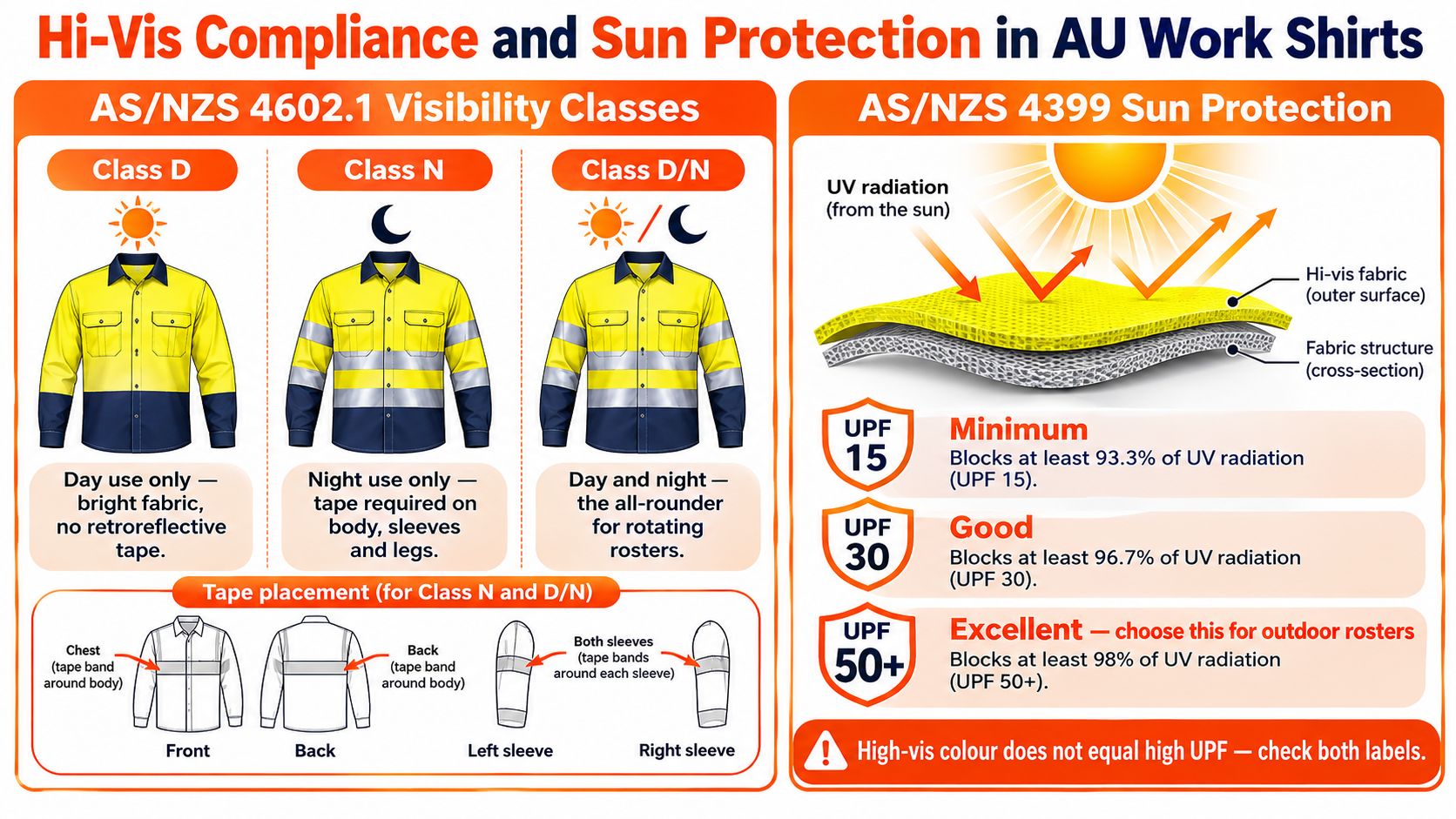
Hi-vis shirts are not all the same, and the label matters as much as the colour. In plain English, Class D is for day use, Class N is for night use, and Class D/N covers both day and night conditions. If a crew moves across roadwork, shutdowns and late finishes, D/N is often the practical choice because it avoids swapping shirts when the roster changes.
What to check before you buy
The shirt has to place tape where the standard expects it, and the cut has to support that tape position. If the torso is too short, the banding ends up sitting wrong when the wearer reaches or bends, and if the sleeve is too long or too loose, the tape can end up buried under cuffs or layers.
For sun protection, the benchline in Australia is UPF 50 or 50+ for outdoor work, because ARPANSA classifies 50 and 50+ as “Excellent” protection and uses the standard for workwear labels (ARPANSA sun-protective clothing guidance). Long sleeves, collars and enough torso coverage matter because the garment can only shield what it covers.
Practical rule: if a hi-vis shirt looks compliant in the pack but rides up when the wearer climbs or reaches, it's only partially doing the job.
The important distinction is that high-visibility fabric colour doesn't automatically mean high UV protection. Buyers need both labels, the visibility class and the UPF rating, and they need the cut to support real coverage on the body.
If you're sourcing a yellow shirt for site issue, the product page for Outrig Supply Co hi-vis yellow workwear is a useful reminder that colour alone isn't the brief, compliance and coverage are.
Matching Shirt Styles to FIFO, Shutdown and Warehouse Work
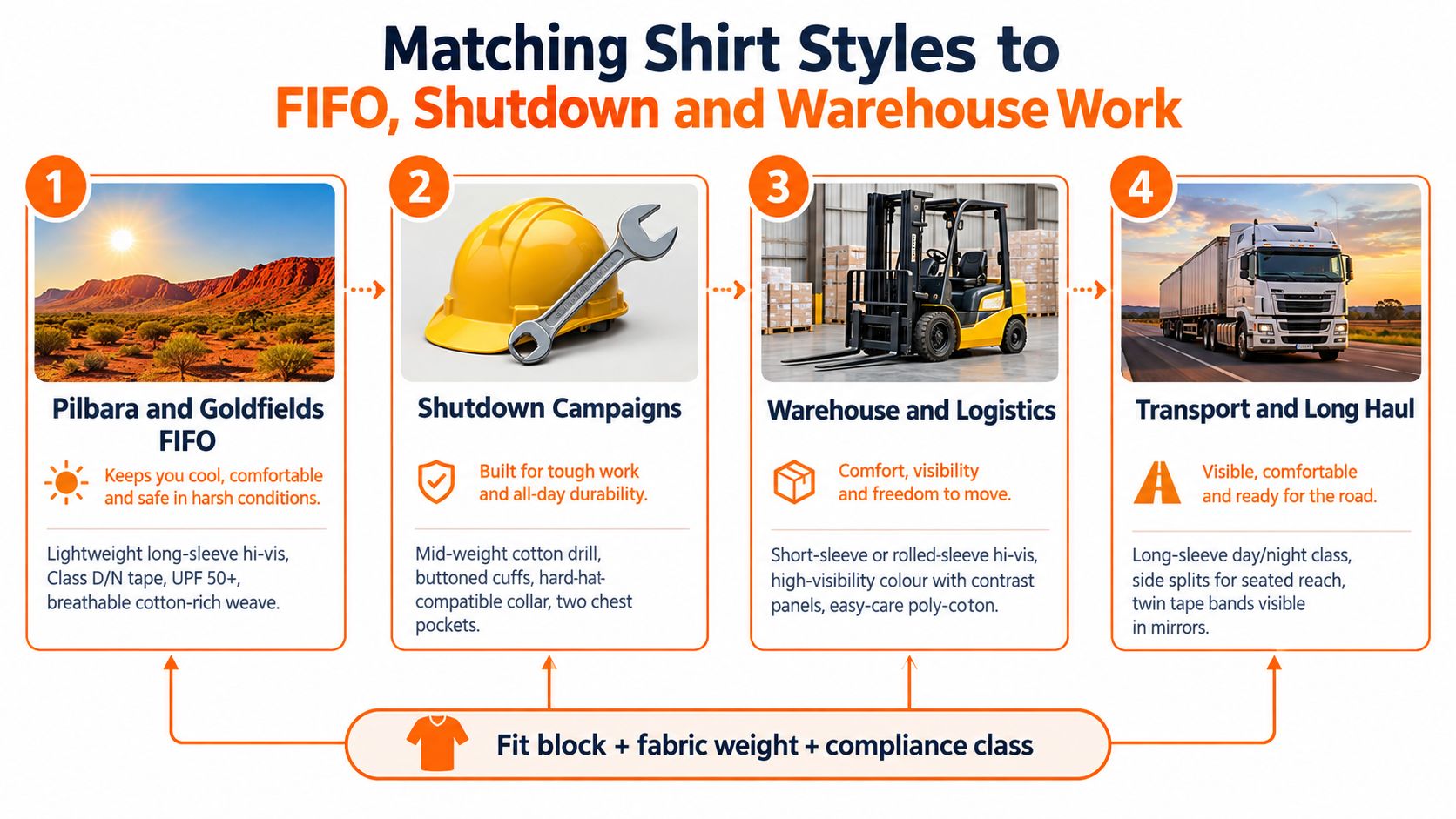
The best shirt for a FIFO roster is usually not the best shirt for a warehouse floor, and that's where a lot of procurement goes sideways. Fit, fabric and compliance have to be matched to the job, not just to the colour palette. The same women's block can work across roles if the construction is right, but the collar, sleeve, tape layout and weight should change with the task.
Four practical shortlist types
Pilbara and Goldfields FIFO calls for a lightweight long-sleeve hi-vis with D/N tape, UPF 50+ and a breathable cotton-rich weave. The priority is heat management without losing visibility during long outdoor stretches and roster rotation.
Shutdown campaigns need a mid-weight cotton drill button-up with buttoned cuffs, a hard-hat-friendly collar and two chest pockets. That combination stands up better to tear-down work, tool carry and repeated contact with rough surfaces.
Warehouse and logistics crews usually do better in short-sleeve or rolled-sleeve hi-vis with contrast panels and easy-care poly-cotton. The shirt has to cope with repeated movement, sorting, lifting and enough wash cycles to stay presentable.
Transport and long haul work benefits from a long-sleeve day/night shirt with side splits for seated reach and twin tape bands that stay visible in mirrors. Seated work exposes fit issues fast, so the hem and sleeve shape matter more than they do in static roles.
The key idea is simple. Start with the block, add the right fabric weight, then confirm the compliance class and pocket layout against the actual site task. Anything else is just buying a shirt because it exists.
Where to Buy Women's Work Shirts in Australia
Buyers in Australia usually end up choosing between specialist trade labels, larger workwear chains and general merch brands that have only recently added women's blocks. Specialist Australian names like Bisley Workwear, FXD and KingGee are often the first stop because they're more likely to stock site-relevant cuts and hi-vis options, but consistency across runs still matters more than a logo on the collar.
What the sourcing channels really mean
Workwear portal suppliers can be useful when a site needs logo application, controlled colourways and a single ordering path for a whole crew. The downside is that bulk certification and women's sizing don't always line up neatly, and print lead times can stretch once the order moves into embroidery or screen work.
General merch brands can offer a women's block, but that doesn't automatically make them fit for site issue. If a label added women's sizing for casual wear first, the shirt may look right on a hanger and still fail under harnesses, hi-vis vests or hot-weather roster use.
A useful mental model is this, decide whether you need year-round stock, crew customisation, or fast replacement. Those three needs rarely come from the same supplier, which is why procurement managers often split the order, standard shirts from one channel, printed logo work from another.
| Supplier Type | Women's Block Fit | Bulk Print Lead Time | AS/NZS 4602.1 Compliance | Typical MOQ |
|---|---|---|---|---|
| Specialist AU trade label | Usually stronger | Varies by decoration | Often available on selected lines | Lower for stock, higher for branded runs |
| Workwear portal supplier | Often controlled, depends on brand | Can be longer with decoration | Common on hi-vis ranges | Usually set by print or embroidery |
| General merch brand | More variable | Usually longer if printed | Not guaranteed | Depends on style and stock depth |
For crew orders, the smartest move is to sample one shirt in the actual women's block before you lock a bulk run. That single step catches shoulder drop, torso length and sleeve issues before you end up with a crate of shirts nobody wants to wear.
Buyer's Checklist and Common Questions Before You Order
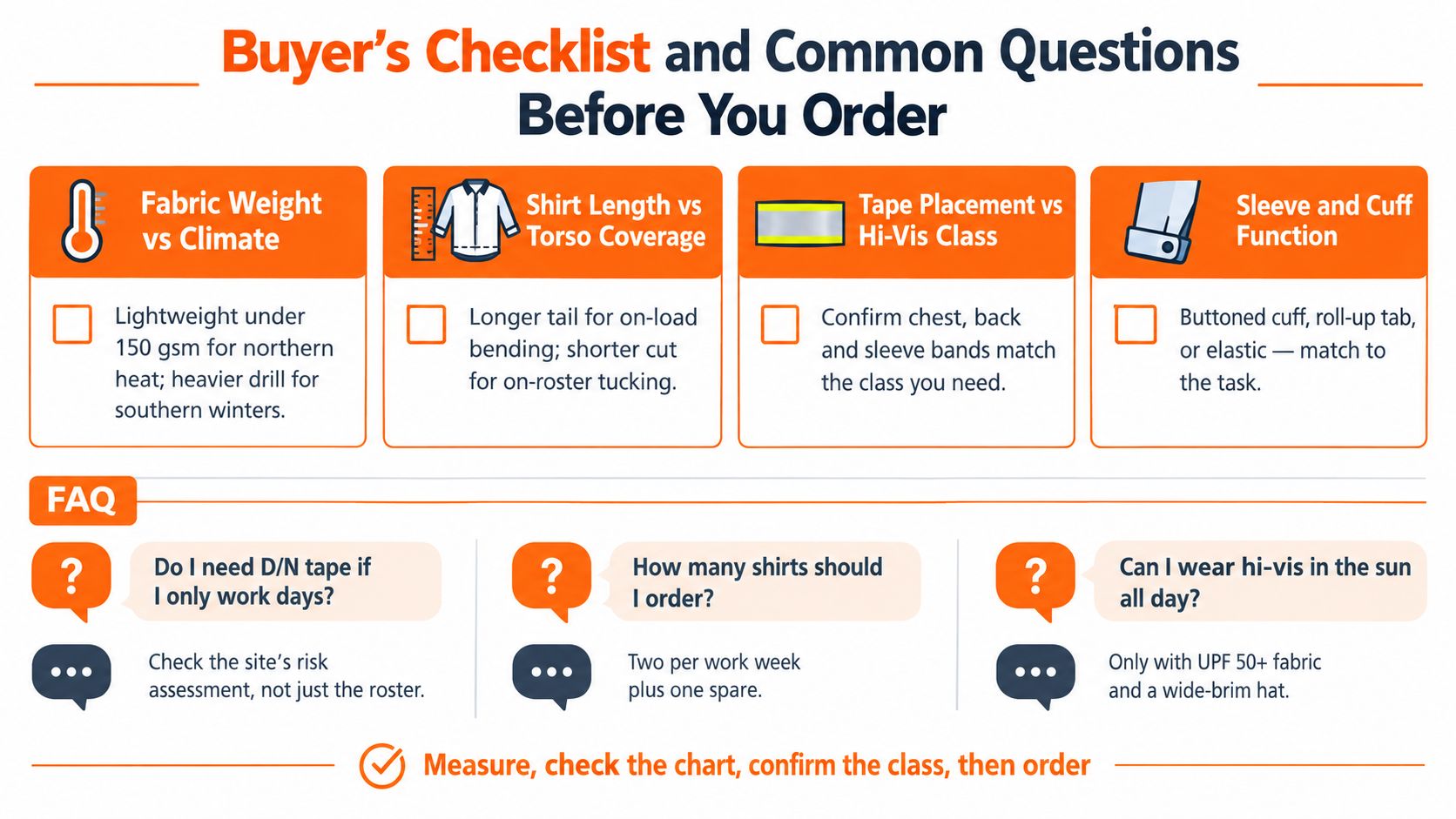
Use the same checklist whether you're ordering one shirt for yourself or 80 for a shutdown crew. First, match fabric weight to climate, lighter for northern heat, heavier drill for colder or rougher work. Then confirm shirt length against torso coverage, because the hem that stays tucked on site is the one that doesn't ride up on overhead work.
Pre-order checklist
- Fabric Weight vs Climate: pick a cloth that suits the roster, not the showroom.
- Shirt Length vs Torso Coverage: check front and back length against bending and reaching.
- Tape Placement vs Hi-Vis Class: make sure chest, back and sleeve banding match the required class.
- Sleeve and Cuff Function: choose buttoned cuffs, roll-up tabs or elastic only if they suit the job.
The next question is usually printing and returns. For crew rollouts, screen-print and embroidery almost always add time, so get sample approval before you release the whole order. If workers can't try on before dispatch, build the order around actual measurements, then keep a spare size or two for swaps when the first roster lands.
FAQ
- Do I need D/N tape if I only work days? Check the site's risk assessment, not just the roster.
- How many shirts should I order? Two per work week plus one spare.
- Can I wear hi-vis in the sun all day? Only with UPF 50+ fabric and a wide-brim hat.
Work shirts womens Australia buyers get the best results when they measure first, compare charts second and treat compliance as part of fit. That's how you avoid the expensive version of the same mistake twice.
Outrig Supply Co makes apparel and crew gear for crane operators, riggers, FIFO workers and shutdown crews, and that includes women's tees with a relaxed fit and clear sizing for crew orders. If you're trying to standardise shirts for site issue or replace a women's block that keeps missing the mark, visit Outrig Supply Co and compare the range against your crew's measurements, compliance needs and lead times.