

An early start is already underway when a crane crew enters the laydown area. The light is weak, a loader is reversing nearby, and everyone is wearing several layers against the cold. The question isn't whether reflective tape clothing looks like site gear. The question is whether the complete garment helps an operator recognise a person, meets the site's requirements, and stays effective after dust, washing and hard use.
Reflective tape is one part of that system. Fluorescent background fabric supports daytime visibility, retroreflective trim returns light from headlights or lamps, and garment design keeps the wearer recognisable as a person in motion. A branded hoodie may help identify a crew, but it shouldn't be mistaken for mandated personal protective equipment.
This guide covers how reflective visibility works, how Australian standards separate materials from finished garments, where tape needs to sit, how wear affects performance, and how supervisors can choose between identity apparel and certified safety clothing.
Table of Contents
- Why Reflective Tape Clothing Matters on Australian Sites
- How Reflective Visibility Evolved for Australian Workplaces
- Australian Standards That Govern Reflective Tape Clothing
- Reflective Tape Versus Compliant High-Visibility Garments
- Where Reflective Tape Should Sit on Workwear
- How Wash, Dust and Wear Reduce Reflective Performance
- Choosing Crew Apparel Versus Certified Safety Clothing
- Practical Checklist for Reflective Tape Clothing Decisions
Why Reflective Tape Clothing Matters on Australian Sites
A shutdown crew rarely works in one lighting condition. A rigger may start before sunrise, move between a crane pad and a laydown area, then finish after dark while mobile plant continues operating. In those moments, visibility becomes a control issue, not a clothing preference.
A vehicle operator doesn't need to see a bright logo. They need to identify a person, understand where that person is facing, and notice movement against machinery, stockpiles and dark backgrounds. Tape that disappears under a harness, folds at the waist or becomes covered by an outer layer can't support that recognition pattern properly.
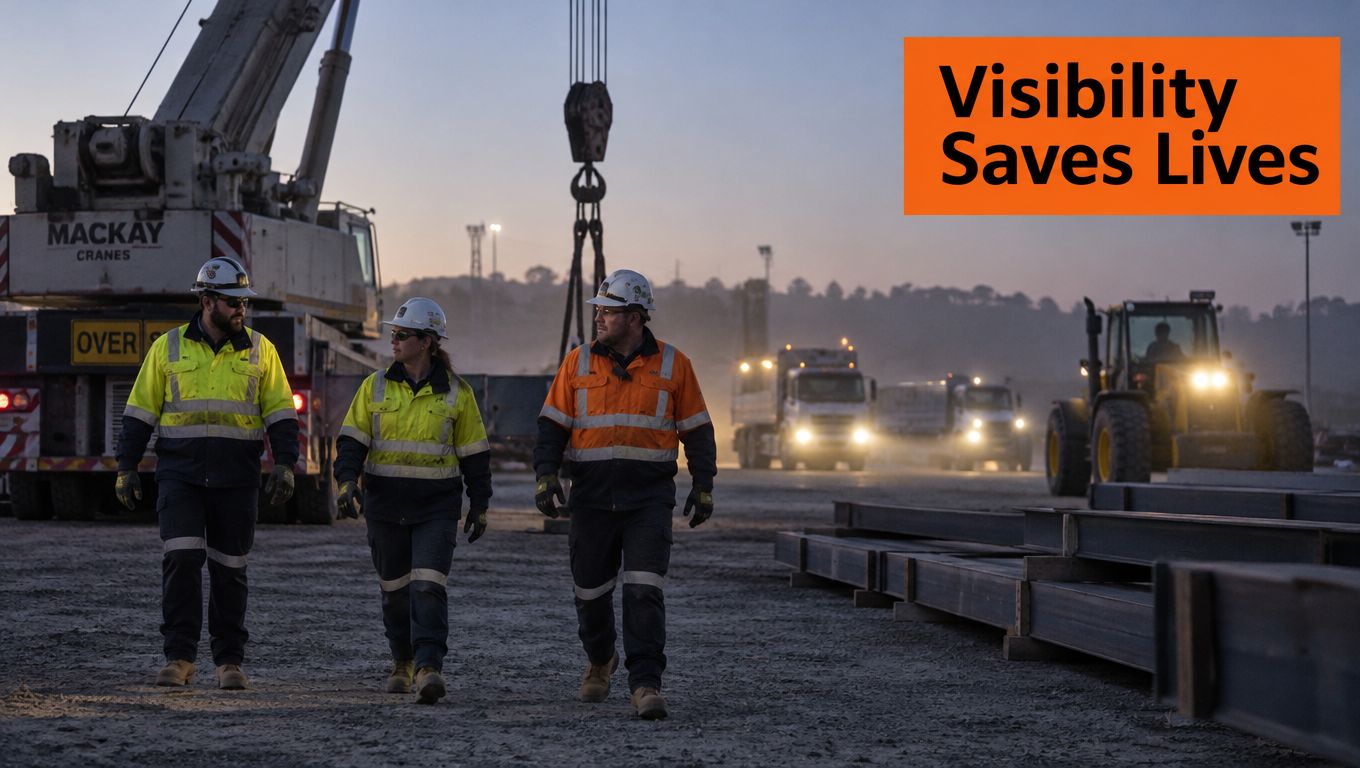
The practical distinction matters for crane operators, doggers, riggers, mining crews and FIFO teams. Each group may need apparel that communicates crew identity, but the worksite may separately require a garment with a specified visibility class, colour, design and documented compliance.
Site rule: Treat reflective tape as a visibility component within a risk-control system, not as proof that any garment is compliant.
The right purchase therefore starts with the task. Ask whether workers are near reversing vehicles, moving plant, road traffic, night operations or poorly lit work areas. Then check the garment, its label and the employer's PPE requirements. This approach prevents two common errors: relying on ordinary clothing with added tape, or assuming that a visibly bright garment automatically satisfies the site's safety requirements.
How Reflective Visibility Evolved for Australian Workplaces
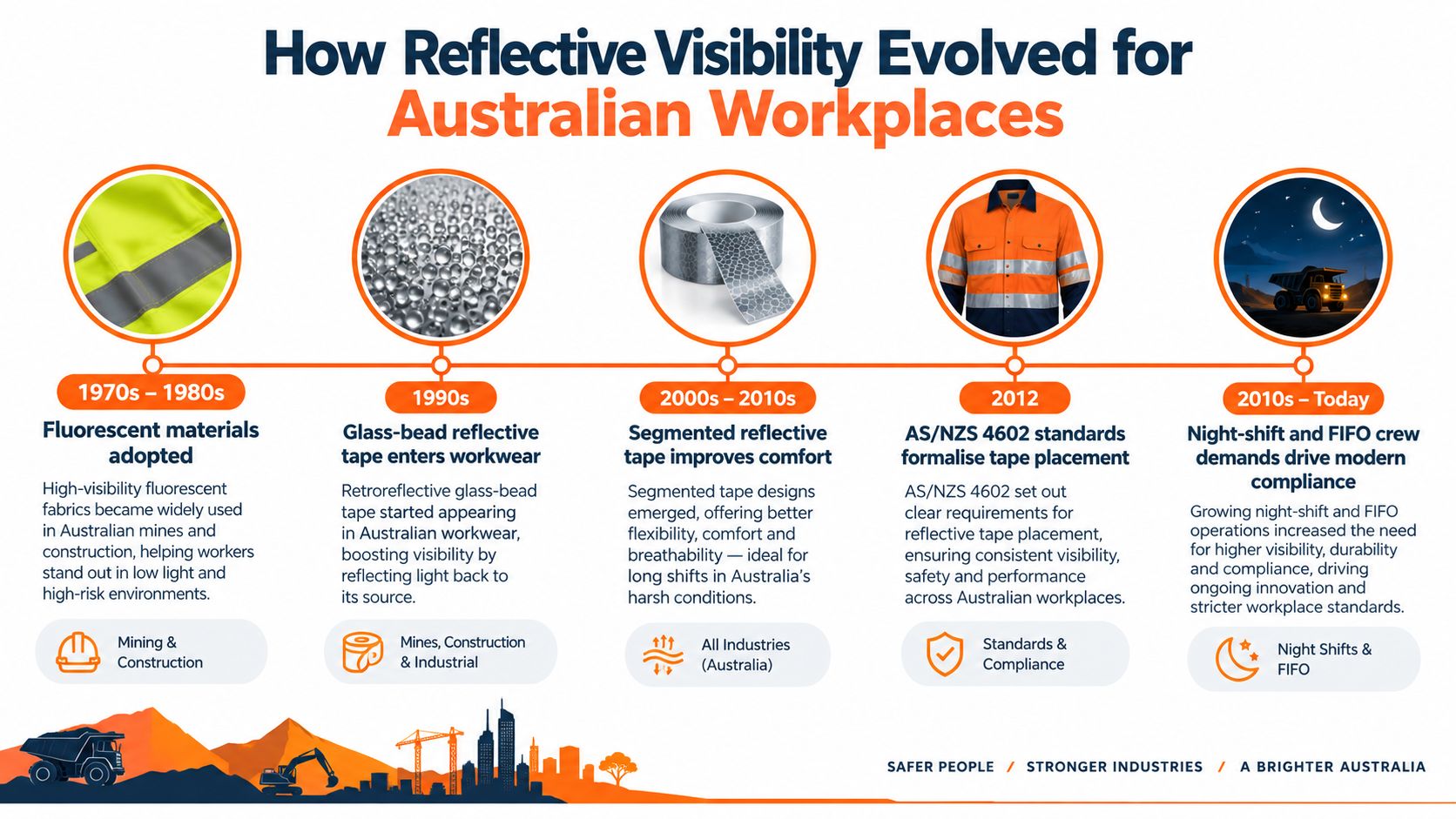
Australia's high-visibility workwear culture developed through two different technologies working together. Fluorescent background materials help the wearer stand out in daylight, while retroreflective tape returns light towards its source in darker conditions. A garment that uses only one approach leaves a gap when the lighting changes.
Standards Australia records that Bob and Joe Switzer developed fluorescent and reflective materials after Bob's eyesight was damaged while unloading crates. Their work helped establish the visibility principles behind high-visibility vests, which remain mandatory in many Australian work environments approximately 90 years later. The story is useful because it shows that visibility clothing didn't begin as a fashion feature. It grew from a practical need to make workers easier to see.
Why material standards became necessary
Colour alone can't describe how a material behaves when struck by headlights. Standards Australia published AS/NZS 1906.4:2010, covering retroreflective materials and devices for road-traffic-control safety garments. That material-focused benchmark recognised that tape needs its own performance requirements rather than being judged only by the colour of the finished garment.
Roadwork also has a dedicated visibility provision in clause 4.21 of AS 1742.3:2019, which addresses high-visibility clothing for personnel working on roads. Proposed updates involving pink and green vest colours, blended materials and clearer treatment of natural fibres show that industry practices continue to change.
For a crew buyer, the history leads to a simple conclusion. Reflective tape clothing sits inside Australia's traffic-control and mobile-plant safety culture. It isn't enough to ask whether a strip shines under a torch. You need to understand what the material does, how the garment uses it, and which work environment the clothing is intended to control.
For cold starts and night work, the Outrig Supply Co Hi-Vis Hoodie – Orange/Black is one example of a high-visibility hoodie with reflective piping detail, heavyweight fleece and contrast panels. Its product information also says buyers should confirm the required colour, visibility class and PPE requirements for their specific site.
Australian Standards That Govern Reflective Tape Clothing
Australia's framework assesses high-visibility clothing in relation to workers exposed to moving traffic, plant or equipment. The standard history matters because it shows how the requirements have become more specific over time.
The foundational AS/NZS 4602 was published on 5 September 1999 and covered garments intended for daytime visibility, nighttime visibility through retroreflected light, or both conditions, as recorded by Standards Australia. Its successor, AS 4602.1:2011, was published on 17 February 2011 for high-risk occupational applications. That edition later received amendments in 2016 and 2020, so buyers shouldn't treat the older wording as a permanently fixed reference.
The current garment framework
The current AS 4602.1:2024 edition was published on 28 June 2024. It expanded to 58 pages, compared with 20 pages listed for the 2011 edition, and continues to address conspicuity for occupational garments used around moving traffic, plant and equipment. Fire-service garments are excluded.
The companion material benchmark is AS/NZS 1906.4:2010, which addresses retroreflective materials and devices used in road-traffic-control safety garments. In plain terms, one standard family helps address the material, while the garment standard addresses how the finished clothing is designed and used.
Procurement checkpoint: Request evidence for the complete garment and the applicable edition. A tape specification alone doesn't establish that a hoodie, shirt or jacket meets the site's requirements.
That distinction is why a plain-English guide to hi-vis tape can be useful for understanding the component, but it shouldn't replace a site-specific PPE decision. The employer, principal contractor or safety team still needs to determine the required garment class and conditions of use.
Road crews also need to account for AS 1742.3:2019, which contains a dedicated provision for high-visibility clothing used by personnel working on roads. For crane, rigging, mining and shutdown work, the safest purchasing process is to match the whole garment to the risk assessment, then verify its documentation before issuing it.
A trade tee such as the Outrig Supply Co Heritage Badge Heavy T-Shirt may suit camp, travel days or off-site crew representation. Its product information describes a heavyweight 280 GSM cotton construction and printed branding, not a substitute for a mandated high-visibility garment.
Reflective Tape Versus Compliant High-Visibility Garments
Adding reflective tape to an ordinary hoodie doesn't automatically turn it into compliant safety clothing. That assumption causes trouble because material performance and garment compliance are separate questions.
AS/NZS 1906.4 concerns high-visibility materials. AS 4602.1 concerns the finished occupational garment, including design, placement and visibility requirements. The garment may also need the right fluorescent background area, tape configuration, visibility class and suitability for the work environment.
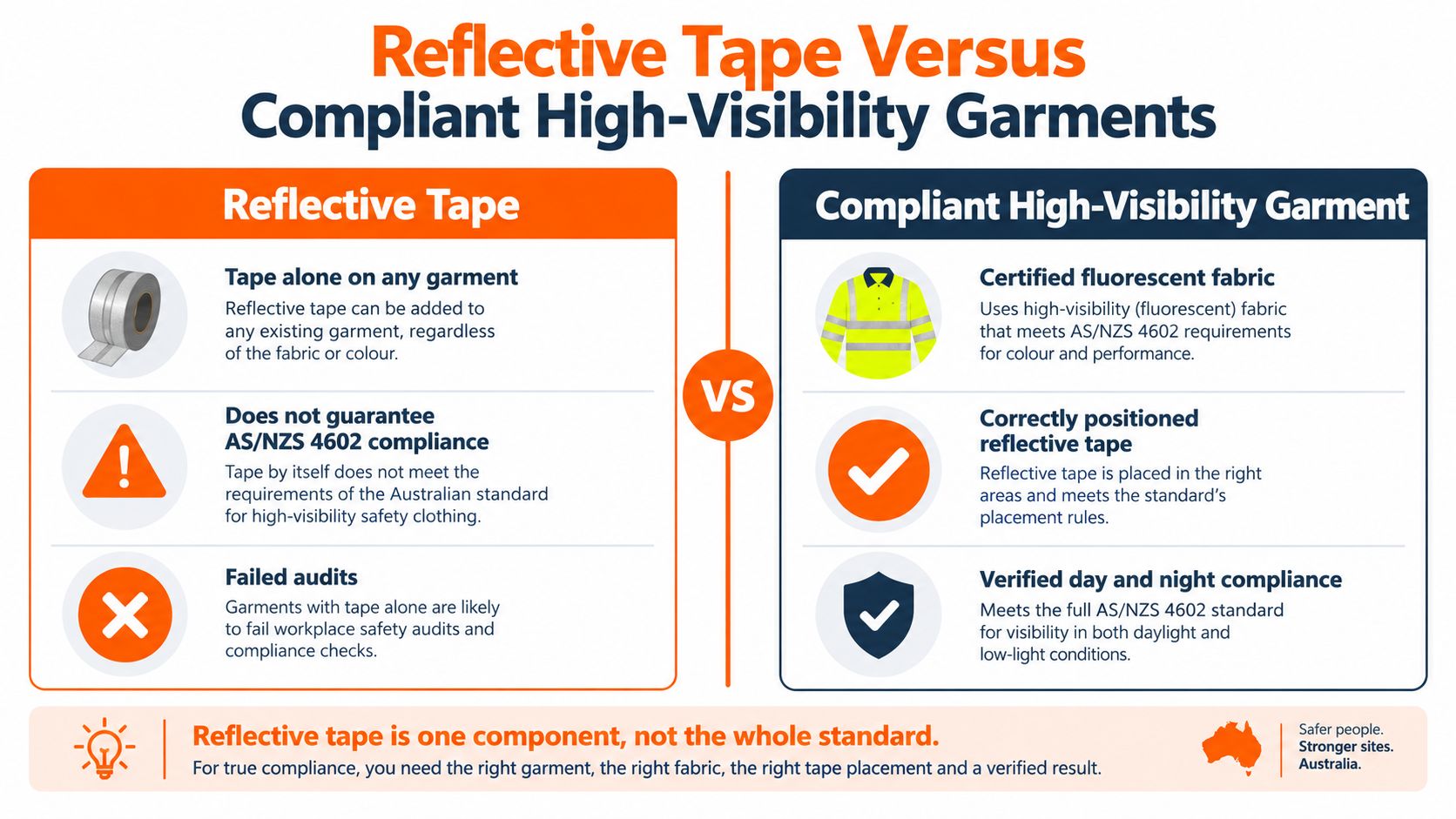
A hoodie can look highly reflective under a phone flash and still be the wrong garment for a reversing zone or night shutdown. Tape may be correctly manufactured, but the finished item can fail to provide the required background material, coverage or configuration. The current AS 4602.1:2024 framework also introduced risk-based Levels 1 to 3, which makes older references to AS/NZS 4602.1:2011 worth checking rather than accepting without question.
Use a two-part decision
For identity apparel, reflective piping or tape can help a crew remain more visible and maintain a consistent appearance. It may be suitable for travel, camp, low-risk areas or situations where the site doesn't prescribe certified PPE.
For required PPE, the complete garment must be specified for the intended risk. Procurement should request the applicable Australian standard, garment information and any declaration or certification supplied by the manufacturer.
The difference is not academic. A branded garment can carry a crew name and still be unsuitable for work beside mobile plant. Conversely, a compliant safety garment can be branded without losing its primary purpose, provided the branding doesn't obscure the required materials or trim.
For additional context on garment selection, the hi-vis shirts guide should be treated as product education, not as a replacement for the employer's PPE specification. The practical test is simple: does the whole garment meet the requirement for this task, or does it merely contain reflective material?
Where Reflective Tape Should Sit on Workwear
Retroreflective tape works by returning incident light towards its source. A headlight strikes the tape, the material sends a strong return towards the vehicle, and the operator gets a clearer visual signal. That only helps if the tape remains visible from useful viewing angles and contributes to a recognisable human outline.
AS 4602.1:2024 identifies retroreflective trim as a design element within high-risk occupational garments, including waist-level placement and garment design classes. Placement isn't just a matter of making the garment look balanced. It helps observers recognise a torso, shoulders and movement rather than seeing an isolated bright strip.
Check the garment in working position
Look at the clothing as the worker wears it, not as it hangs on a rack. A jacket may cover a shirt's waist tape, a backpack may hide the back panel, or a harness may interrupt the torso pattern. A hood pulled up can also alter the visible outline around the head and shoulders.
Use these checks before issuing garments:
- Torso and waist: Confirm that required trim remains visible when the worker bends, reaches and climbs.
- Front, back and side views: Check that plant operators can see more than a narrow strip from one direction.
- Layering: Make sure a vest, hoodie or jacket doesn't conceal the tape on the layer underneath.
- Normal equipment: Test the garment with harnesses, backpacks, radio straps and other items used on the task.
- Lighting: Remember that tape needs a light source, while the worksite still needs suitable illumination.
Safe Work Australia's traffic-management guidance advises that nighttime clothing should be appropriately reflective and that workers and worksites should remain well illuminated. Tape improves the clothing system, but it doesn't replace floodlights, lamps, traffic separation or a reversing procedure.
How Wash, Dust and Wear Reduce Reflective Performance
A new garment can look excellent under a torch and still lose useful performance through ordinary site abuse. Mud, dust, grease, abrasion, folding and poor fit can reduce the visible retroreflective area. Backpacks and harnesses can cover trim even when the tape itself remains intact.
Durability also varies by product. Australian guidance gives examples of ratings for 25, 50 or 100 domestic washes at 60°C, while other guidance says many high-visibility garments remain compliant for roughly 30 washes unless the manufacturer specifies otherwise, as outlined in fabric material specifications from Workcraft. Those figures describe stated wash guidance, not a universal replacement schedule.
Inspect the condition, not just the wash count
Wash-life is only one input. A garment used around abrasive rigging equipment or red dust may deteriorate sooner than a lightly used garment with the same nominal rating. Repeated folding, contamination and sunlight can affect the tape and the surrounding fabric in different ways.
Before each shift, check:
- The surface: Look for heavy soil, grease or dust that blocks the reflective face.
- The edges: Check for lifting, peeling or detached sections.
- The tape face: Look for cracking, dulling or abrasion.
- The fit: Confirm that the garment sits correctly and isn't hidden by another layer.
- The record: Note laundering cycles and remove damaged garments from service.
A torch check can help identify an obvious loss of brightness, but visual brightness alone isn't proof of compliance. Clean garments according to the manufacturer's instructions, store them so the tape isn't unnecessarily folded, and replace clothing when the trim is cracked, detached, heavily abraded or visibly dull.
Safe Work Australia's guidance also places visibility within a broader traffic-management system. Workers and plant operators may need reflective clothing, but they may also need worksite illumination and other controls, particularly where vehicles or mobile equipment operate.
Choosing Crew Apparel Versus Certified Safety Clothing
Supervisors usually need two different clothing solutions. One supports crew identity and everyday wear. The other satisfies a defined PPE requirement in a specific risk environment. Problems start when the first is presented as the second.
A branded hoodie may make sense for camp, travel days, site arrival, cold breaks or crew representation. A garment used beside moving plant, in a reversing zone or during a night shutdown needs a more careful check against the site's risk assessment and required visibility level.
| Decision point | Crew identity apparel | Certified safety clothing |
|---|---|---|
| Main purpose | Represents the team and supports everyday wear | Controls visibility risk in a defined work environment |
| Selection basis | Fit, warmth, branding and practical features | Applicable standard, garment design, colour and required class |
| Evidence required | Product details and care instructions | Whole-garment compliance evidence and site acceptance |
| Typical risk | May be unsuitable as mandated PPE | Must still be inspected, maintained and worn correctly |
The choice isn't always either-or. A crew can use branded apparel away from the active work zone and issue compliant high-visibility clothing for tasks involving mobile plant. Branding may also be possible on safety garments, but it shouldn't cover fluorescent background material or reflective trim.
Supervisor's test: If removing the logo would leave you unable to explain why the garment meets the site's PPE requirement, don't issue it as mandated safety clothing.
Before ordering, confirm the employer's required colour, garment class and documentation. Check whether the clothing needs to support daytime visibility, nighttime visibility or both. Then consider fit, layering, pockets, warmth and wash instructions so workers can wear the garment correctly throughout the shift.
A cotton drill shirt option may suit trade representation or general workwear, but its role shouldn't be confused with a certified high-visibility garment unless the complete product documentation supports that use.
Practical Checklist for Reflective Tape Clothing Decisions
A reliable purchase decision can be reduced to checks that a supervisor, buyer and worker can all understand. Keep the process tied to the task rather than to the appearance of the tape.
Before ordering
- Define the exposure: Identify moving traffic, mobile plant, reversing areas, night work and lighting conditions.
- Confirm the requirement: Ask the employer or principal contractor which colour, visibility class and PPE specification apply.
- Check the whole garment: Request evidence for the finished garment, not only the tape material.
- Review the design: Confirm that fluorescent background material and retroreflective trim suit the intended risk.
- Test the layers: Consider jackets, hoodies, harnesses, backpacks and radio straps that may cover the trim.
- Plan the fit: Allow enough room for required layers without creating loose or obstructed clothing.
Before each shift
Inspect the tape and fabric for mud, dust, grease, cracking, lifting, abrasion and dulling. Check that the waist and torso areas remain visible and that a vest, jacket or harness hasn't hidden the intended pattern.
During the garment's life
Follow the manufacturer's washing instructions and record laundering where crews issue clothing at scale. Don't use the wash count as the only retirement rule. Replace a garment when physical damage, contamination or fading affects the visible area, even if the nominal wash guidance hasn't been reached.
Keep site lighting and traffic controls in the same conversation. Reflective tape clothing can return headlight illumination, but it can't control vehicle speed, separate pedestrians from plant or illuminate a dark work area.
The final distinction should remain clear: crew apparel supports identity, while certified safety clothing supports a defined PPE requirement. Some garments may serve both roles, but only after the complete garment has been checked against the applicable Australian standard and site rules.
Outrig Supply Co offers trade-representative clothing, high-visibility apparel, crib bags, headwear and crew gear for crane operators, riggers, FIFO workers and shutdown teams. Visit Outrig Supply Co to review apparel options or discuss crew orders, then confirm every garment's colour, visibility class and PPE suitability with your site before use.