

A hi vis shirt only counts if it stays visibly compliant from purchase through wash cycles and long daylight-to-night shifts. For Australian workwear, that means checking the requirements of AS 4602.1:2024 and retaining at least 0.2 m² of unbroken high-visibility material across the front and back torso where the applicable guidance calls for it.
The shirt that looks excellent at uniform issue can look very different after a week on the tools. Fluorescent fabric fades under harsh sun, reflective tape becomes dirty or damaged, and an extra jumper can cover the very material that made the garment visible in the first place. A shutdown crew doesn't need hi vis shirts that are merely bright on day one. It needs workwear that remains identifiable when the sun drops, the yard lights come on and the laundry has been running all week.
For crane operators, riggers, doggers, rail workers, FIFO crews and maintenance teams, the buying decision is therefore bigger than colour or logo placement. You need to match the shirt to the shift, the hazard, the layering system, the crew's body shapes and the way garments will be washed, inspected and replaced.
Table of Contents
- Why Hi Vis Shirts Decide What You See on Site
- Australian High-Visibility Standards That Matter for Workwear
- Choosing Fluorescent Colours and Retroreflective Materials
- Sizing and Fit That Keep Crews Safe and Comfortable
- Maintaining Visibility After Washing and UV Exposure
- How to Choose Hi Vis Shirts for Your Crew and Site
Why Hi Vis Shirts Decide What You See on Site
At shift change, visibility can change before anyone has changed clothing. The crew may begin in strong afternoon light, move beside a haul road as the sun disappears, then continue under work lights while mobile plant crosses the work area. An operator needs to distinguish a person from the background, and a spotter needs to remain recognisable while moving between equipment, loads and access points.
That makes hi vis shirts a communication tool. Colour helps the wearer stand out in daylight, while retroreflective material returns light towards a headlamp or work light in darker conditions. The shirt also has to remain visible while the wearer bends, reaches, climbs, carries gear and adds or removes layers.
The site question is more useful than the catalogue question
A catalogue might tell you that a shirt is fluorescent, reflective or suitable for workwear. A procurement lead needs to ask different questions:
- What light will the crew work in? A daytime-only shirt may not suit a crew that remains in a yard after dark.
- What can cover the shirt? Jackets, harnesses, tool belts, rainwear and radio equipment can interrupt the visible surface.
- How hard is the garment used? FIFO and shutdown crews often face intense UV, dust, sweat, grease and frequent laundering.
- Can the crew move safely? Tight sleeves restrict work, while excess fabric can catch on equipment or bunch up across the torso.
- What does the site require? The employer, principal contractor or rail operator may specify colour, class, coverage and approved suppliers.
I've seen teams focus on the purchase price, then spend more time replacing faded shirts and resolving inconsistent uniform choices during a shutdown. The cheaper shirt stops being cheap when workers won't wear it comfortably or supervisors can't tell whether it still meets the site's visibility expectations.
Practical rule: Buy for the darkest, dirtiest and most layered part of the shift, not for the conditions in the product photograph.
A useful example is a crane crew moving from a daylight lift into an evening rigging task. The shirt needs to work with the crew's outer layer, preserve torso visibility and keep reflective elements exposed. Guidance on shirts for mobile crane crews is useful when appearance, role identification and practical site wear all matter, but it doesn't replace the requirements of the specific worksite.
Australian High-Visibility Standards That Matter for Workwear
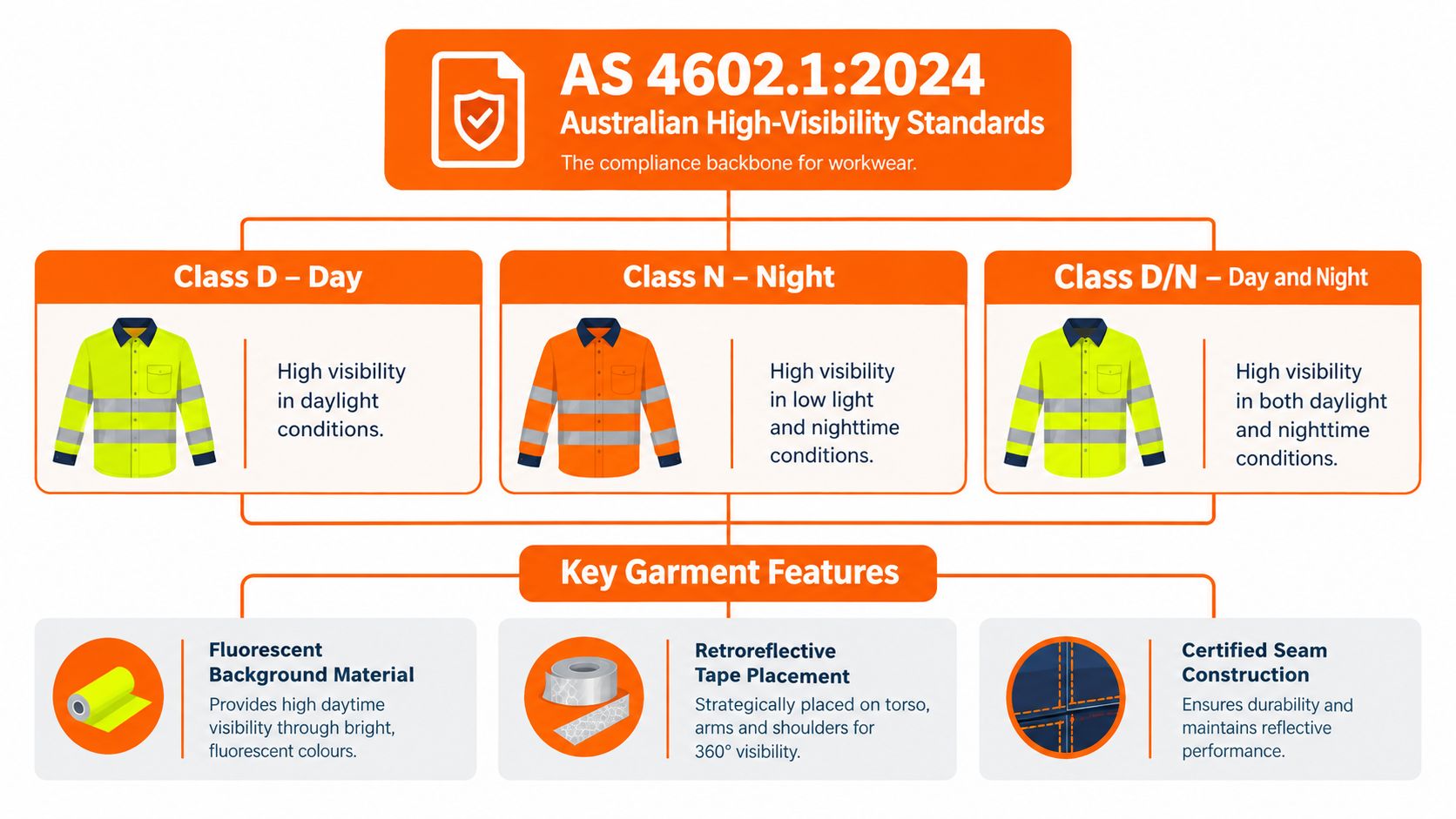
Australian buyers should start with the applicable standard, then choose the garment. AS 4602.1:2024 sets conspicuity requirements for high-visibility safety garments worn by workers exposed to moving traffic, moving plant or equipment in high-risk situations. The standard covers garments intended for daytime-only use, night-time-only use with retroreflected light, and garments designed for both day and night conditions. The current framework is outlined by Standards Australia.
That distinction matters for a shutdown crew. A shirt selected for daylight work isn't automatically the right choice for a night maintenance task, even if both jobs happen on the same site. Confirm the classification required by the employer and assess the full clothing system, especially if a jacket or hoodie becomes the outermost layer.
Read the class against the shift
Industry guidance associated with AS/NZS 4602.1 identifies Class D for daytime use, Class N for night-time use and Class D/N for garments intended for both. Day garments depend on fluorescent background material. Night garments depend on retroreflective performance, while combined garments need both elements.
The garment class is only one part of the selection. Coverage, tape layout, seam construction, colour and the condition of the material all affect how the shirt performs in use. A certification label at purchase doesn't give a worn, stained or damaged garment a permanent pass.
Rail work also shows why generic purchasing can fail. Transport for NSW specifies orange high-visibility colour for rail-corridor clothing in accordance with AS/NZS 1906.4, while shunters in nominated maintenance centres and yards wear yellow, or lime-yellow, garments. Its personal protective equipment guidance also sets torso coverage requirements, including coverage above the waist, extension below the waist at the front and coverage of the buttocks at the back.
For cold starts and night work, a hoodie may be part of the clothing system, but the site still decides whether its colour, visibility class and construction are acceptable. The Outrig Supply Co Hi-Vis Hoodie – Orange/Black is described as a high-visibility orange and black fleece layer with reflective piping, a microfibre-lined hood and a unisex fit. Its stated care instructions specify a cold machine wash, no bleach and no tumble drying. Those product details help with procurement, but site approval remains essential.
Choosing Fluorescent Colours and Retroreflective Materials
Colour selection should follow the hazard and site rule, not personal preference. Fluorescent orange and fluorescent yellow are both used in Australian work environments, but a particular industry, rail operator, principal contractor or employer may prescribe one. Transport for NSW, for example, specifies orange in rail corridors and yellow, or lime-yellow, for shunters in nominated maintenance centres and yards.
Fluorescent fabric works by making the wearer stand out in daylight and other conditions where visible light is available. Retroreflective material serves a different purpose. It directs incident light back towards its source, helping a person stand out when illuminated by vehicle headlights, lamps or work lights. A day-and-night garment needs the two materials to work together.
Placement beats decoration
Tape placement matters because the wearer is rarely standing still with arms at their sides. A good design keeps reflective elements visible across the torso and around the body as the worker turns, reaches or walks. Pockets, logos, harnesses and radio straps shouldn't cover or interrupt the areas the garment relies on for conspicuity.
Industry guidance linked to AS/NZS 4602.1 states a minimum of 0.2 m² of unbroken high-visibility material across both the front and back torso. The AS/NZS 4602.1 guidance also explains the practical distinction between Class D, Class N and Class D/N garments. Check the actual garment documentation rather than assuming that a bright shirt meets every class.
| Visibility Class | Typical Site Use | Key Design Focus |
|---|---|---|
| Class D | Daytime work where fluorescent visibility is the primary requirement | Approved fluorescent background colour and sufficient unbroken torso coverage |
| Class N | Night-time work where retroreflected light is required | Retroreflective material, placement and condition |
| Class D/N | Mixed day and night shifts | Fluorescent background material combined with retroreflective material |
What works in real conditions
A shirt with broad, functional reflective placement generally gives a crew more useful visibility than one covered in narrow decorative details. Contrast panels can help keep workwear looking organised and hide grime, but they must not reduce the required high-visibility area or create uncertainty about the garment's class.
The same principle applies to branding. Keep logos and patches away from critical reflective surfaces unless the garment supplier and site rules allow the placement. The practical reasoning behind orange, black and white workwear choices is relevant to crew identity, but the compliance decision still rests on the approved garment design and the site's PPE requirements.
Sizing and Fit That Keep Crews Safe and Comfortable
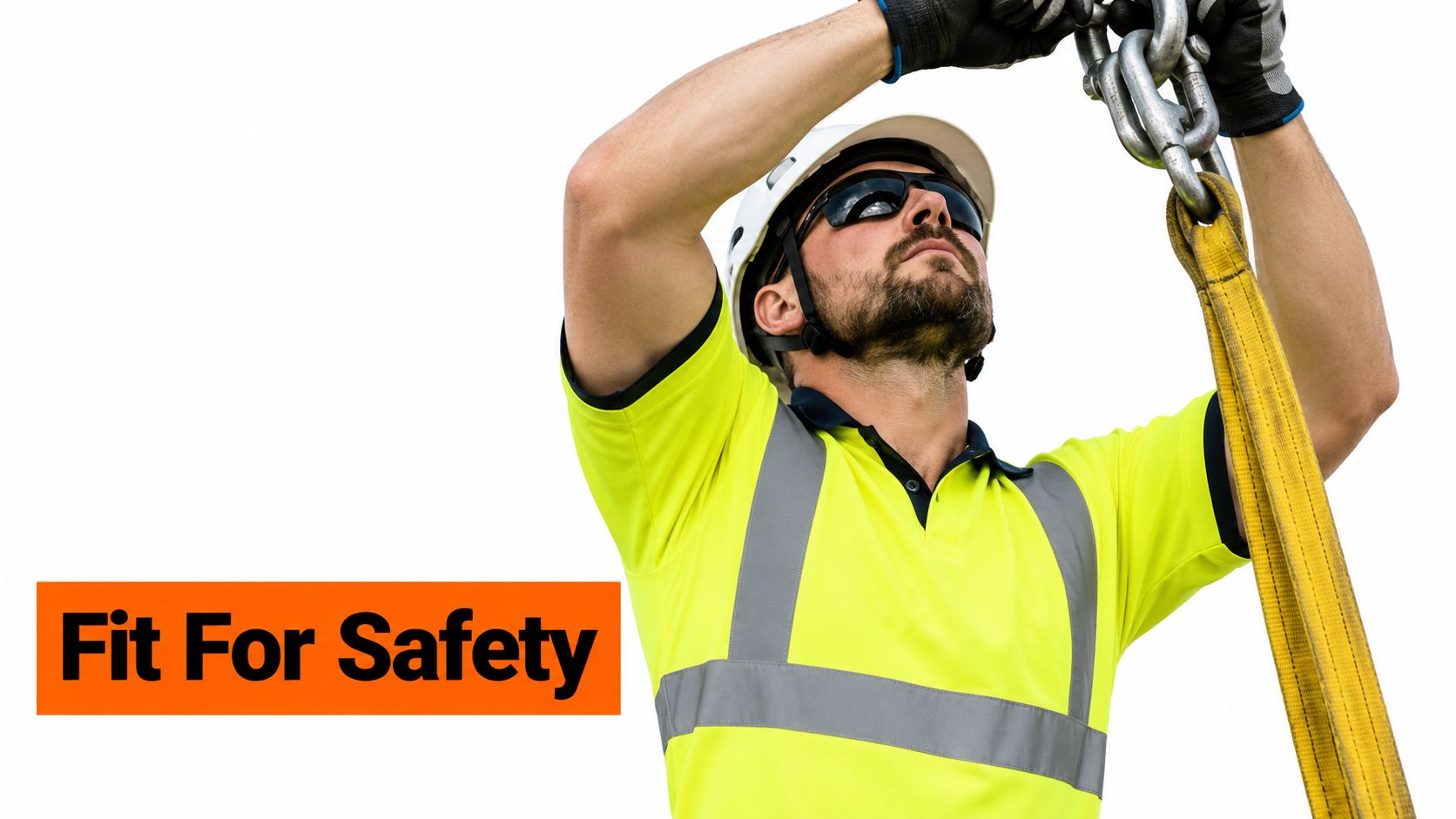
A rigger reaches overhead mid-lift and the shirt rides above the waistband. That is a fit failure, not a fabric failure. A shirt that's too small pulls across the chest and limits movement. One that's too large can bunch under a harness, snag on gear, or leave the high-visibility area sitting where it should not.
Start with the measurement the supplier uses, usually chest circumference. Our guide on how to measure yourself for workwear when ordering online walks through the chest and torso steps. Measure over the base layer the worker normally wears, then allow for the mid-layer used during cold starts. Do not take one person's measurement and apply it to the whole crew. Body shapes vary, and size labels are not consistent across brands or garment cuts.
Build the size order around movement
Ask each worker to check four points before a bulk order:
- Chest and torso coverage: The shirt should cover the torso properly without riding above the waist during normal work.
- Shoulder and arm movement: Reach overhead, pull a rope, and cross the arms. Seams should not bind and sleeves should not pull back excessively.
- Layering room: Try the shirt over the base layer and any approved mid-layer. Do not size it only for a hot-weather T-shirt.
- Harness and equipment interaction: Check that straps, radio clips, and tool belts do not push the shirt into folds or cover required material.
Women on mixed crews should not have to choose between a restrictive smaller unisex shirt and an oversized larger one. Women-specific cuts can improve shoulder, chest, and waist fit, while inclusive size ranges give procurement teams more options. The Australian workwear shirt range reflects the market's move toward women's hi-vis options and broader workwear fit choices, but every worker should still test the cut against the actual task.
Bulk ordering without avoidable returns
For a shutdown, issue a measurement sheet before ordering and record the worker's preferred base-layer combination. Order samples in representative cuts, including a women's fit where available, then test them through the movements the crew performs. A fitting session gives better results than relying on a size chart alone.
A consistent uniform does not mean every worker wears the same cut. It means every worker has the coverage, movement, and layering room the job requires.
Keep a small replacement process in place for transfers, damaged garments, and size changes. That stops supervisors from accepting a poor fit because the original bulk order has closed.
Maintaining Visibility After Washing and UV Exposure
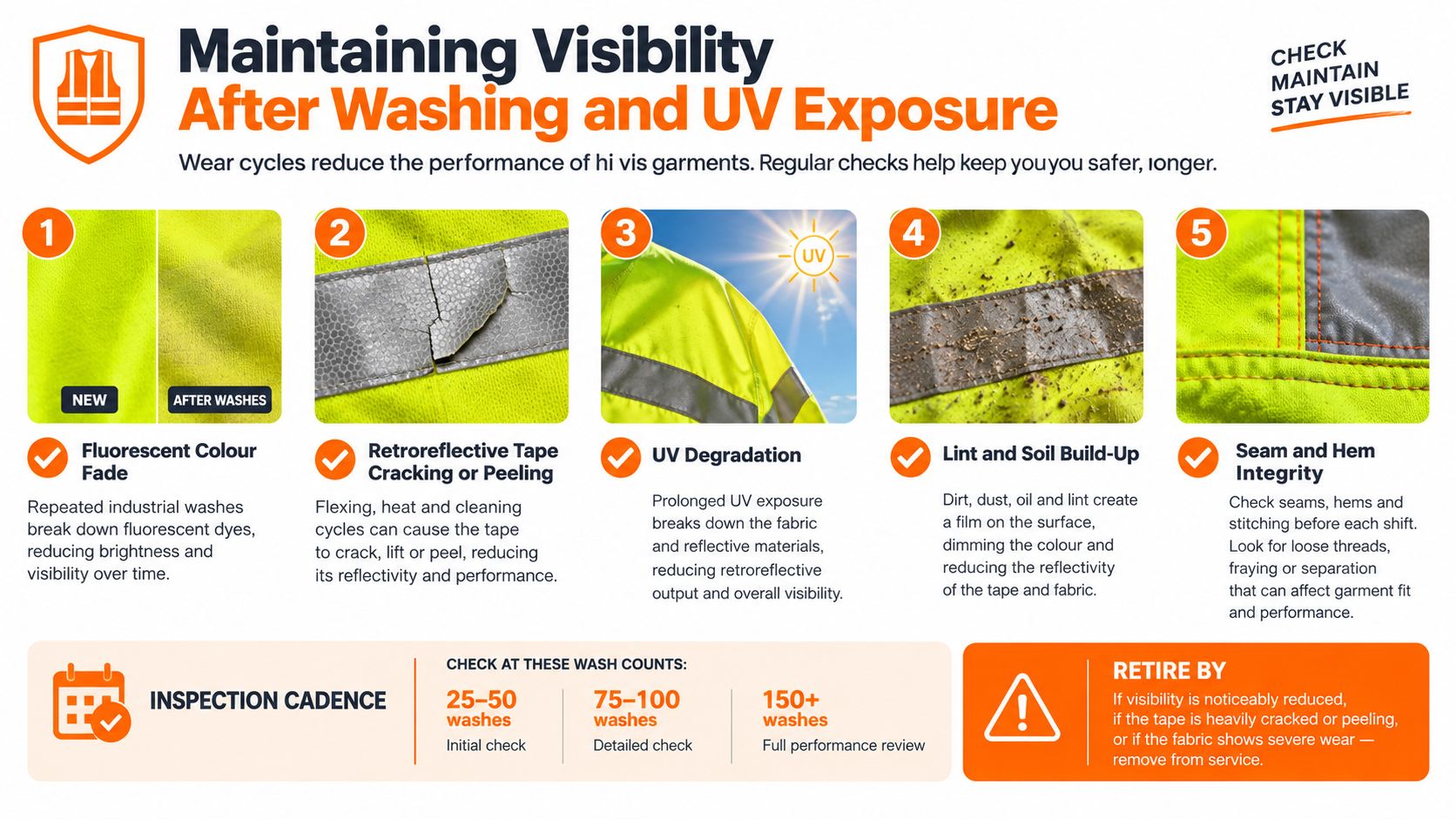
The most overlooked question isn't whether a shirt was compliant when it left the supplier. It's whether the fluorescent colour and reflective material remain effective after ordinary work, washing and weathering. Australian workwear guidance warns that heat, bleach, fabric softeners, UV exposure and repeated washing can degrade hi-vis materials, a concern discussed in Australian hi-vis workwear standards guidance.
FIFO and shutdown garments receive a particularly hard workout. Sun, sweat, red dust, grease, rain, industrial laundry and rough storage all add wear. A shirt can still carry its label while the surface has faded, the tape has cracked or soil has dulled the contrast that operators need to see.
Wash for the garment you need to keep
Follow the garment's care label first, then make the laundry process part of the PPE system. Australian guidance recommends washing hi-vis garments cold or on a gentle cycle, line-drying them in the shade and keeping them away from bleach and fabric softener. Heat can shorten the useful life of the fabric and reflective components, while harsh chemicals can affect colour and finish.
Use a simple care routine:
- Separate contaminated workwear: Remove heavy dirt and site contaminants before the main wash where the garment instructions permit.
- Turn garments inside out when instructed: This can reduce unnecessary abrasion to prints and surfaces.
- Avoid bleach and softener: They can damage the fluorescent and reflective performance the shirt depends on.
- Dry gently: Line-dry in shade rather than exposing wet garments to unnecessary heat or direct sun.
- Store clean and dry: Don't leave damp shirts compressed in a crib bag or vehicle.
Inspect before issuing and before the shift
Supervisors should check the garment, not just the worker's presence on site. Look for fading, permanent staining, frayed hems, loose seams, cracked tape, peeling tape and areas hidden by repairs or added patches. Compare heavily used shirts with a new approved garment if the change is difficult to judge.
There isn't a universal replacement date that suits every crew. Replace a shirt when its colour, reflective material, coverage, seams or fit no longer meet the site's requirement, and record the reason so purchasing can identify whether the problem is laundry, UV, abrasion or garment selection. For high-exposure crews, keep spare stock available before a shutdown begins rather than waiting until several workers fail inspection.
Inspection rule: If a supervisor has to argue that a faded shirt is probably still visible, take it out of service and check the approval requirements.
How to Choose Hi Vis Shirts for Your Crew and Site
A reliable buying process starts with exposure, not branding. Map the crew's work across the whole shift, including daylight, dusk, night work, vehicle interaction, weather and the layers workers will wear. Then match the shirt or outer layer to the site's documented PPE requirements.
Use this procurement sequence
Start with the site rule. Confirm whether the employer or principal contractor requires a specific colour, class, garment type or supplier approval. Rail and maintenance environments can set requirements that differ from a general construction uniform, so a shirt that works for one crew may not be accepted for another.
Match the visibility class to the shift. Choose daytime, night-time or day-and-night capability according to the actual work pattern. If a crew changes from shirts to hoodies or jackets at night, assess that outer garment separately. The visible layer is the layer operators and spotters need to identify.
Check the material and coverage. Review fluorescent background colour, retroreflective placement, torso coverage, seams and any contrast panels. Ask for compliance documentation and care instructions before placing a bulk order. Don't treat decorative reflective piping as proof that the garment meets the required class.
Test fit with the work system. Measure workers individually, include normal base and mid-layers, and test movement under harnesses and equipment. Provide women's cuts and inclusive sizing where those options produce better coverage and mobility. A uniform order is organised when the procurement record reflects actual crew measurements, not when every box contains the same size ratio.
Plan the laundry process. Decide who washes the garments, which detergents and cycles are permitted, how workers dry them and how supervisors identify damaged stock. Make the instructions visible to the people who handle the shirts, not only to the person who placed the order.
Set a replacement trigger. Replace garments when fading, staining, tape damage, seam failure, loss of coverage or poor fit affects site acceptance or visibility. Record failed garments by cause. That information helps you decide whether to change the garment, the laundry process or the storage method.
A practical pre-order checklist looks like this:
- Shift exposure: Day only, night only or mixed conditions.
- Site approval: Required standard, colour, class and documentation.
- Garment system: Shirt, hoodie, jacket or another outer layer.
- Worker fit: Chest measurement, layering room, movement and inclusive cuts.
- Lifecycle care: Cold or gentle wash, shade drying and chemical restrictions.
- Inspection control: Supervisor checks, spare stock and clear retirement criteria.
- Crew consistency: Matching approved garments without forcing one cut on every body type.
The shirt is only one part of the result. Visibility depends on the approved design, the way the crew layers it, the condition after washing and whether supervisors remove worn garments before the next shift. Treat hi vis shirts as lifecycle PPE, and the buying decision becomes easier to defend, easier to manage and more useful on the ground.
Outrig Supply Co offers trade-focused apparel and worksite gear for crane operators, riggers, FIFO workers and shutdown crews, including hi-vis layers, crew clothing and bulk-order support. Visit Outrig Supply Co to review the range and organise workwear that fits your crew's site and shift requirements.