

The usual advice for women's stretchy trousers is to buy the pair with the most give. That's a poor starting point for crane, rigging, FIFO and shutdown work. A soft trouser can feel excellent in the change room, then pull under a tool belt, stretch thin across the seat or leave you dragging a loose knee over grating.
Start with a woven work cloth, a women's pattern and the movement you do most. Stretch should help the garment move, not compensate for a short rise or tight thigh. The useful question isn't how far the fabric stretches in your hands. It's whether the trousers stay secure through a shift and recover after washing.
Table of Contents
- Stretch Levels That Suit Site Trousers
- Why Fit Beats Maximum Stretch
- How to Measure When Charts Disagree
- Cuts That Hold Up to Trade Tasks
- Durability After Kneeling Dust and Wash
- Trial a Pair Before the Next Swing
Stretch Levels That Suit Site Trousers
For crane, rigging, FIFO and shutdown trousers, start with a woven twill carrying 2 to 5 percent elastane. That range gives enough cross-grain give to kneel, climb and crouch while the cotton or poly-cotton body holds its shape under a belt and harness. A knit can stretch further on the rack, but the yarn alone has to pull it back, so seats bag out and knees stay bagged after a few shifts.
Use the blend as a buying filter, then confirm it with a movement trial. Australian commentary on women's PPE and workplace readiness points the same way: fit, comfort and hazard suitability outrank headline stretch figures. Where a site specifies protective clothing, that requirement sits above any fabric preference.
Choose the direction of give
Two-way stretch usually means give across the cloth, though suppliers describe direction inconsistently. Ask whether the finished trouser stretches around the hips and thighs. That is the give you use when bending or kneeling, and it avoids the leg lengthening under load.
Four-way stretch adds lengthwise give, which helps on high steps and deep crouches. I still rate a well-cut two-way woven ahead of it for site work. If recovery is weak, the knee fills with loose cloth that catches on grating, and a shaped woven gets the same movement through the pattern rather than the fibre.
Stretch blends for women's work trousers
| Cloth | Elastane | Stretch | Best for | Watch for |
|---|---|---|---|---|
| Cotton-rich work twill | 2 to 5 percent | Mostly two-way | Harness, belt, standing and bending | Tight in a deep squat if the rise is short |
| Poly-cotton stretch twill | 2 to 5 percent | Two-way, sometimes vertical | Mixed yard and workshop shifts | Heat build-up in dense cloth; check drying behaviour |
| Stretch canvas | Low end of the range | Controlled two-way | Abrasion, cargo and tool-belt load | Limited reach if the cut lacks movement room |
| Panelled seat and knee stretch | Match each panel's declared blend | Local four-way | Climbing, kneeling and ladder work | Seam bulk and heavier reinforcement |
| Fashion knit or ponte | Often well above workwear blends | Commonly four-way | Off-site or employer-approved light duty | Snags, sheerness and unsupported abrasion claims |
Pick the cloth for the load
Cotton-rich twill earns its place under a belt: stable waist, woven face, and none of the stiffness of heavy canvas. Poly-cotton deserves a trial where you move between workshop and yard, but judge the actual fabric. Some synthetic blends dry fast and run cool; dense ones hold heat through a summer shift.
For repeated contact with rough surfaces, favour canvas or local reinforcement. Panelled trousers offer another route: movement cloth at the crotch, seat or knee, with firmer fabric where tools and surfaces rub. Check that the panel seams don't sit directly under your kneecap, or you'll feel the ridge every time you go down on one knee.
Buying rule: Pick the row that matches your hardest repeated movement. Hanger softness fades by the second wash; recovery and cut decide how the trousers wear at hour ten.
Why Fit Beats Maximum Stretch
A woven twill carrying 2 to 5 percent elastane has a fixed stretch allowance, and the pattern decides how that allowance gets spent. A short back rise pulls the waistband down when you crouch regardless of elastane content. A narrow thigh puts the cloth under tension before you have taken a step, using up give that should have been saved for the movement itself.
Australian tradeswomen's findings reported by Ragtrader found 40% felt less safe in ill-fitting garments, while 33% said incorrect clothing limited how hard they could work. Both figures describe garments cut for the wrong body, where raising the stretch percentage only masks the sizing failure.
Room has to sit where the movement happens: the seat for kneeling, the back rise for crouching, the thigh for stepping up into a cab.
Check the pattern before the fabric
In Australian construction PPE-fit research, 80% of 475 surveyed users rated obtaining properly fitting trousers as moderately difficult to difficult. A hang-tag claim about flexibility deserves less weight than the block underneath it.
A useful women's block is drafted around the relationship between waist, hip, seat and thigh, rather than a scaled-down men's garment. Look for these features together:
- A contoured waistband that follows your body without needing a belt pulled excessively tight.
- Seat and thigh room that lets you bend without forcing every seam into tension.
- Articulated knees that place shaping around the joint.
- Reinforced wear zones without a stiff edge digging into the knee or inner thigh.
- Stable recovery so the garment returns to shape after you stand.
Excess looseness and excess tightness fail differently. Loose cloth can catch on a step, hook or projection. Tight cloth can stop a full squat or pull the waist down as you reach forward.
Test the complete clothing system
Try trousers with the layers you wear on shift. A tucked shirt changes the space inside the waistband, and a thick winter layer changes how the seat feels when you sit.
The Outrig Supply Co Women's Crew Tee is a relaxed women's fit with core crew branding. If that is your usual layer, use it during fitting rather than a thin top that leaves more waistband room.
Comfort doesn't establish PPE compliance. Check required protection separately, including whether your clothing arrangement interferes with harness adjustment or visibility. Our guide to women's high-visibility clothing addresses another part of that site-clothing decision.
For a procurement trial, have women perform their actual tasks in the proposed garment. Record where the waistband moves, where seams press and whether reinforcement stays over the knee. A size label can't tell a supervisor any of those things.
How to Measure When Charts Disagree
Use a flexible dressmaker's tape, a mirror and preferably a helper. Wear the base layer you'll use on shift, empty your pockets and stand normally. Don't pull your stomach in or tighten the tape to reach a preferred size.
First establish whether the chart lists body measurements or garment measurements. They aren't interchangeable. A laid-flat waistband measurement describes the trousers, while a body-waist measurement describes you.
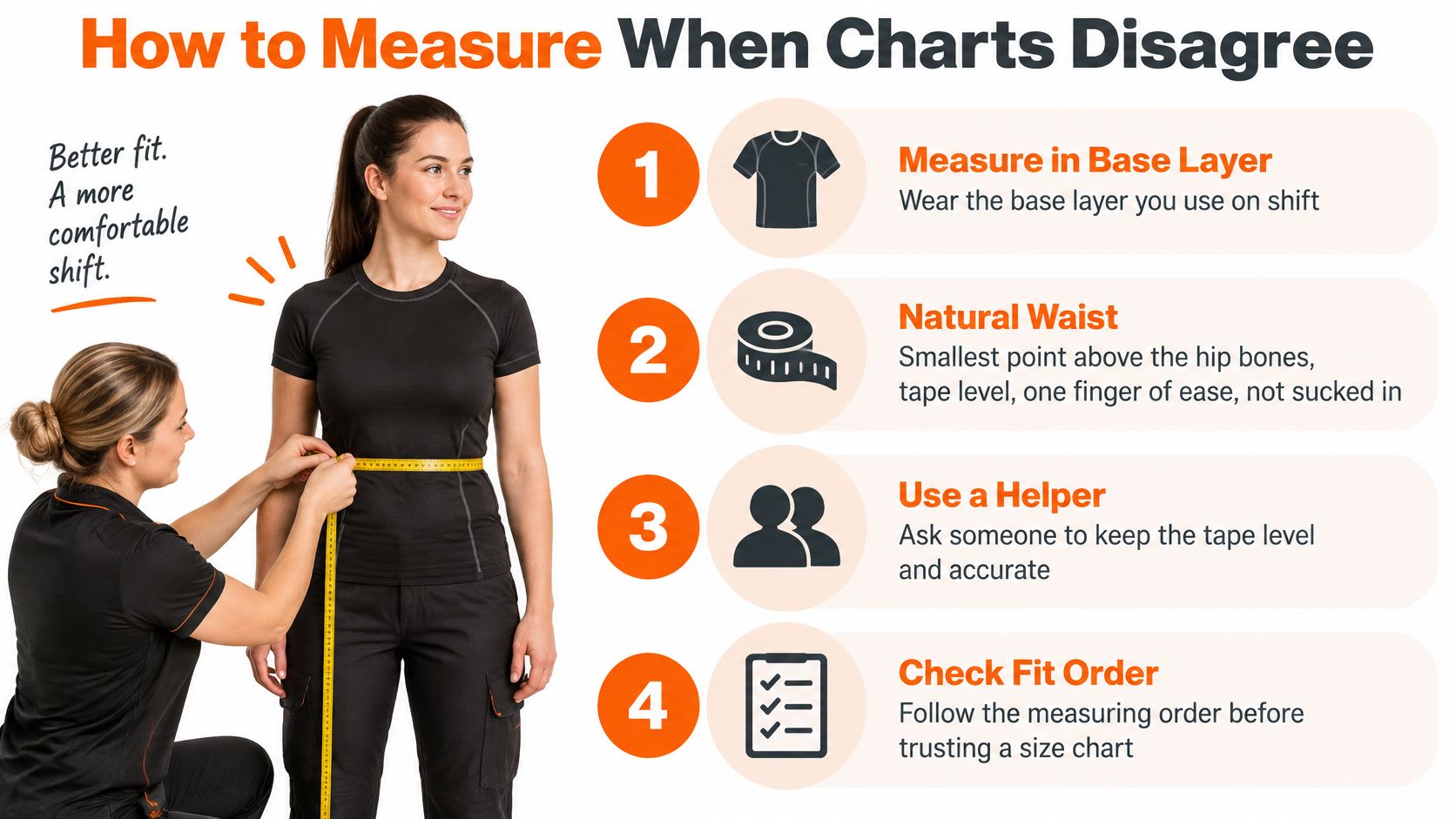
Take measurements in a repeatable order
- Natural waist. Find the narrowest comfortable point above the hip bones. Keep the tape level and snug without compressing your body. Also note where you want the trouser waistband to sit.
- Fullest hip. Measure around the fullest part of your seat with your feet together. Ask your helper to check that the tape hasn't climbed at the back.
- Rise. Use a well-fitting pair as a reference, measuring from the crotch seam to the waistband at the front and back. Don't compare this garment measurement with a body chart unless the supplier explains its method.
- Thigh. Measure around the fullest upper thigh and note the position so you can repeat it. Check both legs if their shape differs.
- Inseam. Measure the inside leg on a pair that works with your boots. Verify the proposed length while wearing those boots, because a cuff that looks right barefoot can collect above the boot or drag behind it.
For a more detailed online-ordering method, use our guide to measuring yourself for workwear. Keep your measurement method consistent between purchases.
Resolve the mismatch without forcing the waist
When waist and hip fall into different sizes, choose the pair that clears your hip and thigh, then assess whether the waistband can secure comfortably. Don't buy the smaller pair expecting stretch to create missing room.
A belt can manage a modest waist difference. It can't correct a waistband that gathers into folds or a crotch that hangs too low. If securing the waist distorts the rest of the garment, choose another cut.
Heatleys' discussion of workwear built for women reinforces why a male-default fit isn't an adequate answer. Women's fit also isn't a single narrow, high-waisted shape: muscular thighs, a longer torso, pregnancy, post-partum changes and winter layering can all alter the best choice.
Keep a dated measurement note on your phone, including your layer and boot choice. Compare the next pair with your body, not with the size printed inside an old men's trouser.
Before ordering, reach into the pockets while wearing your normal belt arrangement. A pocket you can't access with a gloved hand isn't useful storage.
Cuts That Hold Up to Trade Tasks
A crane operator spending much of the shift seated needs something different from a rigger repeatedly climbing and crouching. Choose the cut around the movement that causes trouble, not around a standing photograph.
A straight work leg with a suitable rise is the all-rounder. Articulation and a gusset become more valuable when your work repeatedly asks the knee and hip to bend together.
Match the cut to the movement
Work cuts against site movement
| Cut | Best movement | Waist and pockets | Site risk |
|---|---|---|---|
| Straight work leg, mid to high rise | Standing, short bends and harness wear | Belt loops, clean waist | Can bind if the rise is short at the back |
| Articulated knee with gusset | Kneeling, ladders and deep squat | Stable if rise is long enough | Extra seam bulk if reinforcement is clumsy |
| Contoured stretch waist | Forward bend without roll-down | Partial elastic plus belt loops | Pull-on styles that won't take a belt |
| Utility with flat thigh pockets | Tools on the body and shutdown walks | Secure closure, compact storage | Loaded pockets that block a squat or catch |
| Slim fashion stretch | Off-site use | Often lacks a substantial belt path | May restrict hip and knee or become sheer when tight |
An articulated knee places extra shaping where the leg bends. A gusset adds room through the crotch instead of making the waistband supply every bit of movement. Neither feature helps much if its position misses your body, so kneel and check where the knee panel lands.
For a seated operator, assess the front waistband and pocket openings in a cab-like position. A high front rise can press into the abdomen even when the back rise is useful. You may need a contoured waistband rather than more height all round.
Keep storage out of the bend
Cargo capacity comes with a cost. A loaded thigh pocket can press against the leg during a squat, and a projecting flap can catch where a flatter closure wouldn't.
- Carry compact items securely. Check that the closure stays shut when you kneel.
- Position radios deliberately. Use the approved carrying arrangement rather than assuming a trouser pocket is suitable.
- Keep the belt path usable. Check loop width and placement without confusing trouser loops with harness attachment points.
- Check boot clearance. The cuff should clear the boot without a broad flare or excess folds around the ankle.
A slim trouser isn't automatically restrictive, just as a roomy trouser isn't automatically safe. The deciding point is whether the pattern provides movement without leaving unnecessary fabric around equipment.
End the selection with a plain statement: ladder work, articulated knee and gusset, or cab work, straight leg with a comfortable seated rise. That's more useful than choosing several styles without knowing what each solves.
Durability After Kneeling Dust and Wash
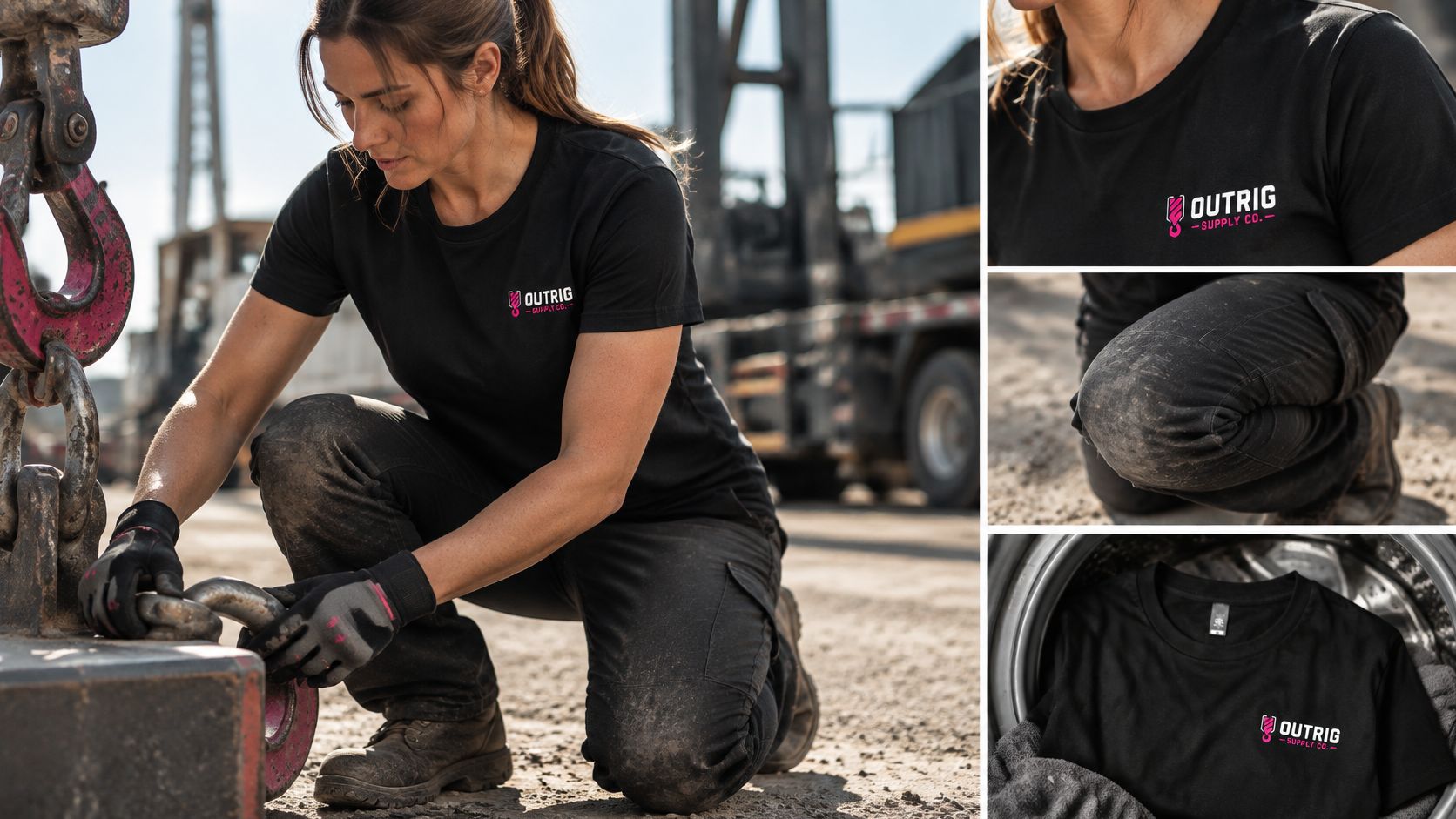
Recovery decides durability more than thickness does. After a shift, look at the knee: cloth that returns to shape still has life in it, and cloth holding a permanent bulge is already heading out. A heavy trouser can fail at a badly placed seam while a lighter woven keeps going, because where the strength sits matters more than how much of it there is. That is why a 2 to 5 percent elastane woven twill earns its place on site: it keeps its return through repeated kneeling and laundering, where a soft four-way knit starts to bag early.
Read the signs of wear
Bagging and abrasion are different failures. Bagging means the garment has stopped returning to shape. Abrasion means the surface yarns are wearing away. A stronger knee patch repairs neither once the base cloth has lost its return, so treat bagging as a fabric problem before you treat it as a reinforcement problem.
Dust shortens fabric life. Grit left in pockets and cuffs acts as an abrasive in the wash, so empty pockets and remove loose dirt before laundering, following the garment's care instructions. If a damp pair feels restrictive straight out of the machine, judge it again once dry in realistic conditions before committing to more pairs.
- Check the surface. Look for thinning, broken yarns and wear around pocket corners.
- Check the shape. Lay the clean, dry trousers flat and compare the knees and waistband with their original state.
- Check coverage. Examine the seat under stretch in good light, especially with lighter colours.
- Check recovery. Fold the freshly washed knee and see whether the crease relaxes out or sets in.
Where a denim construction suits the task, our women's work jeans guide covers another fabric option worth assessing.
Wash for the garment you bought
Follow the care label's temperature and drying limits. Turn trousers inside out where directed, avoid unnecessary heat and keep an iron off stretch panels unless the label permits it. Aggressive washing won't restore a waistband that has already crept; once the elastic goes, no cycle brings it back.
The same label discipline applies to every layer in the rotation.
A trouser that needs constant hiking up is telling you the fit or the recovery is wrong. Check both before you reach for a smaller size.
Pull damaged trousers from site service when a hole, failed closure or frayed hem creates a hazard or compromises required protection. Any repair to protective clothing must preserve its specified performance. A patch improvised in the crib room doesn't guarantee that.
Trial a Pair Before the Next Swing
Before paying, get clear answers about composition, stretch direction, pattern and returns conditions. Ask whether the garment uses a women's block, whether the main fabric differs from its stretch panels and whether the waistband accepts your usual work belt.
Keep the first trial clean and reversible. Read the returns conditions before removing tags, washing the garment or wearing it outside. A returns deadline can close before your first full shift, so the keep-or-send-back call has to happen on the home trial, not at the crib table.
Run a controlled home trial
- Order by measurement. Buy the size your tape and the chart point to, not the label you usually reach for. If you sit between sizes, check whether the policy allows trialling two and returning one.
- Confirm the window first. Note the deadline and what voids it, typically tags off, washing or outside wear. Start the trial the day the parcel lands rather than the week after.
- Keep it reversible. Trial indoors in your normal base layer, socks and boots, with your usual authorised belt arrangement. Tags stay on until you commit.
- Decide on the fail. Don't accept a pair because only one position fails. If that position is part of your job, it's a reason to try a different cut.
Make the work trial count
Once you've accepted the purchase and confirmed site suitability, treat the first swing as the true assessment. Judge the trousers on how they move and hold shape after laundering and repeated shifts, since that is what you are committing to when you reorder.
If your employer issues protective trousers, personal stretch trousers aren't a substitute unless the employer approves them for the task. A comfortable woven garment still needs the required protection for the hazards present.
Trial a pair before buying multiples for the next swing. Keep the composition label and your fit notes, then wear the accepted trousers through a full swing where permitted. Reorder only when the garment has earned that decision through movement, laundering and a complete shift's wear.
We offer women's and unisex crew apparel, headwear and worksite gear for crane, rigging, FIFO and shutdown crews, with our T-shirt styles designed in Western Australia and printed to order in Australia. Visit Outrig Supply Co for crew layers and gear to accompany your workwear, while keeping your trouser choice tied to fit, task and site requirements.