

The usual advice for embroidery work clothes starts with uploading a logo and choosing a chest position. That's the wrong starting point for a shutdown crew. First decide what the garment must do, whether it's certified PPE, and who'll wear it with which equipment.
A cheap bulk order stops being cheap when the embroidered layout isn't acceptable on site, the sleeves catch under a harness, or replacement garments arrive after mobilisation. Treat embroidery as a garment specification and lifecycle decision, not just a decoration purchase.
Table of Contents
- How to Order Embroidery Work Clothes, Step by Step
- Which Work Garments Take Embroidery Safely
- Where to Place Logos Without Breaking Visibility Zones
- Stitch Types, Thread and Backing for Heavy Wear
- Size and Fit for Mixed Crews
- Pilot Samples, Turnaround and Minimums
- Caring for Embroidered Work Clothes and When to Replace Them
- Confirm the Spec Before You Approve the Order
How to Order Embroidery Work Clothes, Step by Step
The decision buyers often skip is whether the finished, decorated garment still suits its intended task. Set that requirement before discussing thread colours or quantity discounts.
Build the order around the job
- Write down the task and shift. Record whether the garment is for daytime, night-time or day/night work, plus the hazards and site clothing requirements. A travel hoodie and an outer garment worn near moving plant need different approval paths.
- Choose the base garment. Specify a tee, hoodie, cap or certified high-visibility item, and request the fabric weight and relevant conformity documents. Don't accept a substitute just because it looks similar, since fabric construction affects both embroidery and wearer comfort.
- Mark the embroidery zones. Show the proposed decoration on the actual garment layout, including reflective tape, fluorescent panels and identification areas. Get approval for the finished arrangement before authorising stitching, not after the decorator has completed the order.
- Select the decoration method. Match flat fill, satin lettering, appliqué or a patch to the artwork and fabric. Simplifying a detailed logo usually produces a more usable result than forcing dense stitching onto a lightweight shirt.
- Have the artwork digitised for that fabric. Supply clean artwork and require underlay suited to the garment's stretch and construction. A stitch file that works on a cap isn't automatically suitable for a knitted tee.
- Approve a sewn and washed pilot. Use the actual garment, thread and backing proposed for production. Keep the accepted sample so later batches can be checked against something physical rather than a screen image.
- Confirm measured wearer sizes. Collect measurements and test the intended layers together before locking quantities. Separate the size allocation from artwork approval so an attractive sample doesn't distract from a poor fit.
- Agree delivery and inspection terms. Confirm the production trigger, dispatch expectations, minimums and responsibility for faults in writing. Arrange an arrival inspection before garments are distributed across camp rooms, vehicles and work fronts.
Keep one controlled order record
Put the garment description, approved layout, size allocation and sample approval into the same order record. Name the person authorised to approve changes, especially if a purchasing officer and site supervisor are sharing the job.
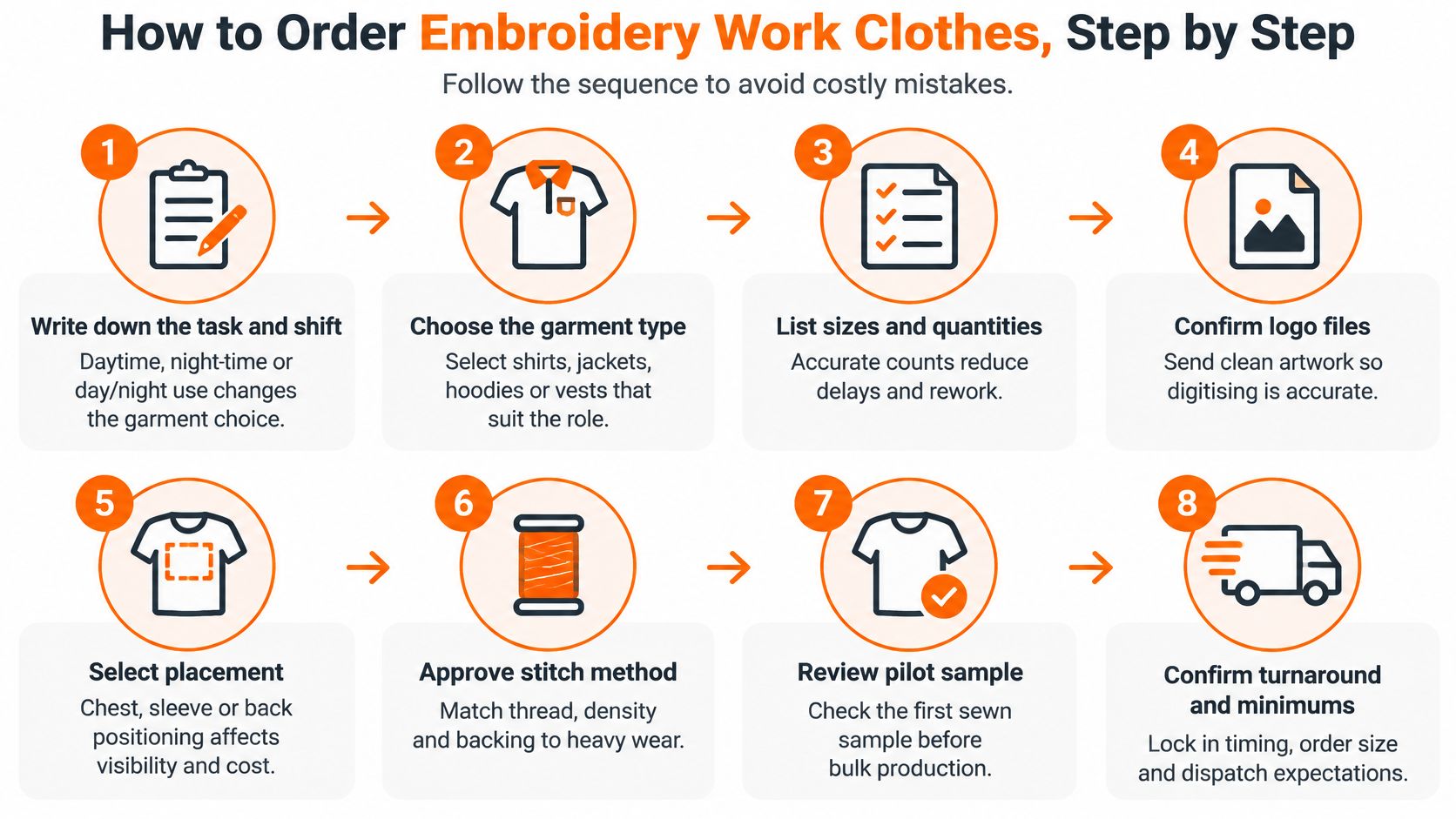
This takes longer than emailing a logo and a headcount. Skipping placement approval is the mistake I'd guard against most closely, because it can leave you with an entire run that can't be issued for its intended task.
Which Work Garments Take Embroidery Safely
Embroidery is a decoration choice, not a safety approval. A heavyweight hoodie does not become protective clothing because it carries a dense logo. For procurement, the key question is whether the exact garment and decoration are permitted for the task and site.
Embroidery suitability by work garment type
| Garment type | Embroidery suitable? | Condition to check before ordering |
|---|---|---|
| Standard cotton or heavyweight tee | Yes | Keep decoration clear of reflective or ID panels |
| Heavyweight hoodie without certification | Yes | Use it as a crew identity layer, not as safety PPE |
| Certified high-visibility D, N or D/N garment | Only where the certified design allows | Keep required fluorescent and retroreflective zones clear |
| Flame-resistant garment | Only with approved FR thread and backing | Get the garment maker to confirm the complete certified system |
| Melt-sensitive fabric | Stitched embroidery only, subject to approval | Heat-applied decoration can distort or damage the fabric |
| Cap | Yes | Check that the front panel is clear of reflective piping or certified markings |
| Insulated crib bag | Yes, on a flat zone | Keep stitching clear of seams, zips and handle anchors |
A cotton drill shirt guide can help with garment selection, but fabric type alone does not establish certification. For protective clothing, confirm that the garment maker approves the thread, backing and decoration together.
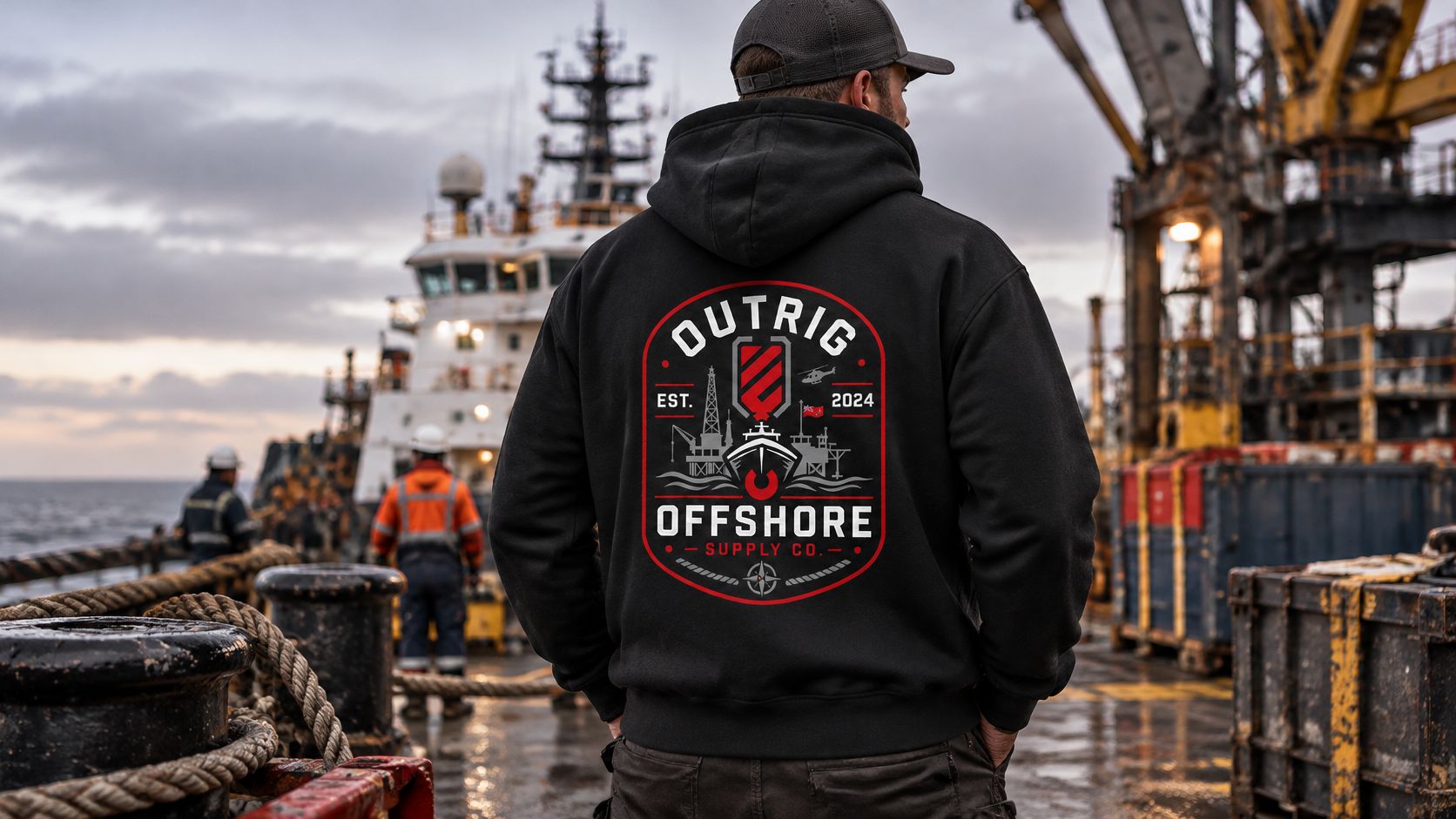
The Outrig Offshore Crew Hoodie is a crew layer, not certified PPE. Confirm the garment's stated standard, the hazard it is intended to address and the site's requirements before approving it for a task. A placement or specification error found mid-shutdown can cost more than the saving on a bulk order.
Where to Place Logos Without Breaking Visibility Zones
Published guidance describing AS 4602.1:2011 indicates that compliant D and D/N garments require at least 0.2 m² of unbroken high-visibility fabric on both the front and back torso, with reflective tape in prescribed configurations. That makes a large, dense torso logo a compliance question, not merely an artwork decision.
Don't treat that area requirement as permission to calculate your own leftover space and start sewing. Obtain documentation for the exact garment and the standard edition required by the purchaser or site, then have the proposed decoration assessed against its certified design.
Logo placement zones on work garments
| Zone | Suits | Avoid when |
|---|---|---|
| Upper left chest | Name or crew role | Certified high-visibility torso area is required to stay clear |
| Outer sleeve above cuff | Crew badge or role mark | Sleeve carries required reflective tape |
| Pocket panel | Small logo or name | Pocket covers an ID panel or harness contact area |
| Back yoke | Larger crew design | Back torso is a required fluorescent area on a certified garment |
| Hood or cap front | Brand mark | Front holds reflective piping or certified markings |
| Hem or waistband | Avoid for decoration | Rubs on harnesses and tool belts; exposed edges can lift during laundering |
Approve positions on the garment, not a blank template
Upper chest and sleeve placements are candidates for approval, not universally safe zones. A seam, tape strip or pocket arrangement can make the same logo acceptable on one model and unsuitable on another.
For a shutdown crew, propose a compact role identifier on the left chest and a name on an approved pocket panel. Reserve the larger back-yoke design for non-certified hoodies where it won't compete with required visibility material.
A familiar logo position isn't evidence that the decorated garment remains compliant.
Harnesses and tool belts also matter. Waistband decoration sits in a high-contact area, while raised patches beneath straps can create uncomfortable pressure and abrasion.
Use our hi-vis shirts guide when organising garment questions. Send the decorator the certified design documentation, mark the exact decoration boundaries, and obtain written layout approval before bulk production starts.
Stitch Types, Thread and Backing for Heavy Wear
A specification balances heat management, abrasion resistance and repeatable quality, rather than chasing maximum stitch density. More stitching can make a logo look substantial while making the garment less comfortable.
Decoration methods compared for work clothes
| Method | Best for | Watch for on work clothes |
|---|---|---|
| Flat fill embroidery | Crisp logos and solid shapes | Dense fills stiffen lightweight fabric and reduce breathability |
| Satin-stitch lettering | Names and crew roles | Narrow borders need checking for fraying under repeated industrial washing |
| Appliqué | Large multi-colour badges | Edges can lift in laundering unless attachment and backing are adequate |
| Patch embroidery | Caps and thick hoodies | Adds bulk where a harness or belt sits |
| Heat-applied transfer | Quick, simple graphics | Not suitable for melt-sensitive fabric without confirmed compatibility |
Specify the materials as well as the method
Safe Work Australia's heat-management guidance recommends loose-fitting, lightweight clothing and identifies wearable cooling systems as possible controls. For Perth, Pilbara and remote-resource work, don't select a heavy base purely because it carries embroidery well.
Use a lightweight or midweight garment where the task permits. For ordinary crew apparel, choose polyester or blended embroidery thread for colourfastness and laundering compatibility, then match the backing to the fabric's movement.
Cut-away backing can support stretchy knits, but its edges shouldn't scratch the wearer or protrude beyond the design. Reinforce attachment where contact demands it, without using extra backing to justify decoration beneath a harness strap or at a rubbing waistband.
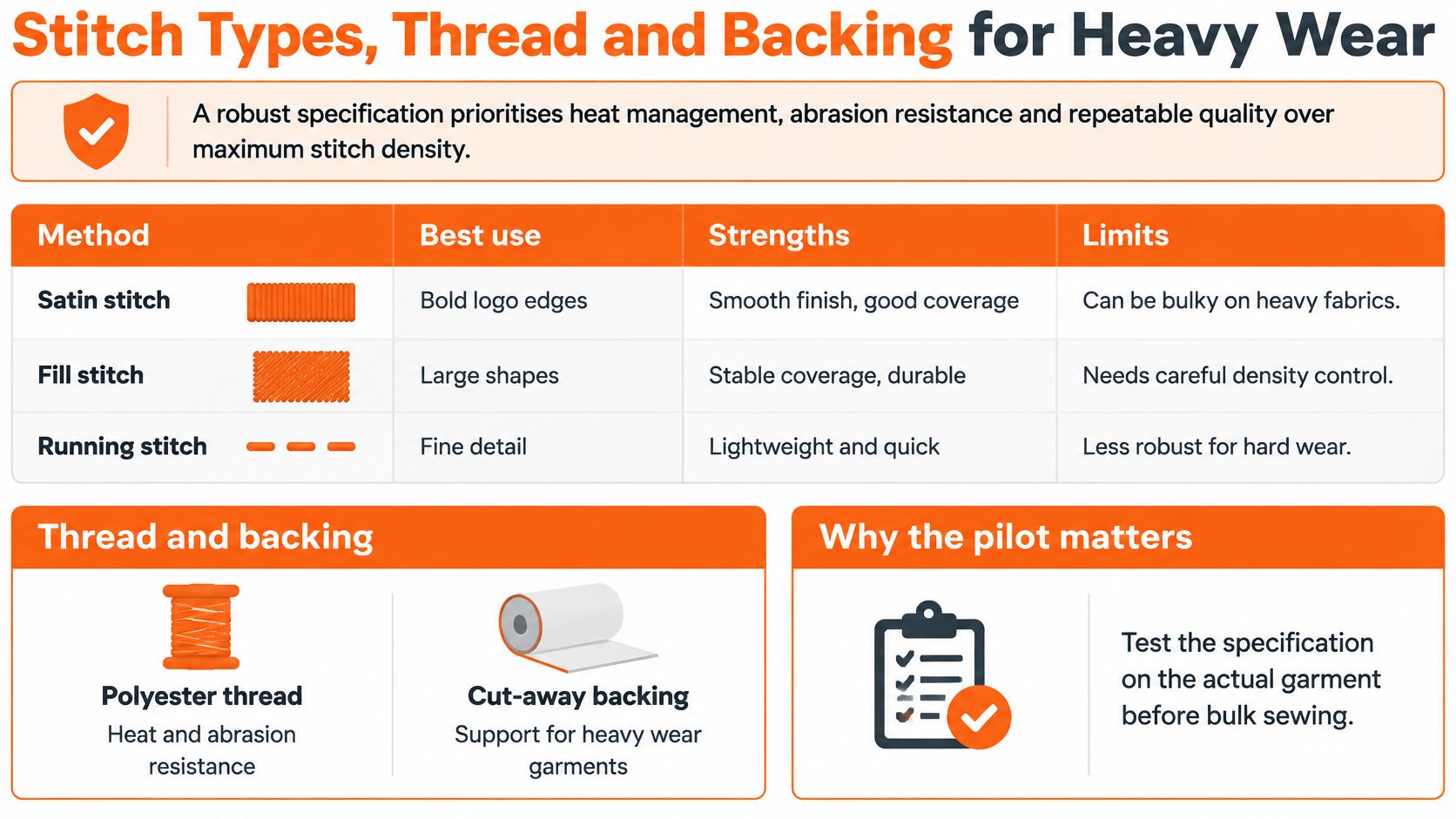
Reduce density before adding support
Dense fills can pucker and stiffen thin fabric. Large chest designs also create a less breathable panel, so simplify artwork or reduce its footprint before asking for heavier backing.
Keep reflective tape, ID panels and equipment contact points out of the stitch path. Ordinary polyester thread isn't a substitute for approved protective-garment components.
Ask the decorator: Which stitch structure, thread and backing will you use on this exact fabric? Put the answer in the quote so production substitutions require approval.
Size and Fit for Mixed Crews
Collect wearer measurements before allocating sizes. A familiar letter on a personal hoodie isn't a reliable purchasing specification across different garment cuts.
- Body measurements: Record chest or bust, waist, hip, sleeve length and height.
- Layering allowance: Note what goes underneath and whether the garment must sit beneath outer PPE.
- Fit requirements: Record preferred cut and movement restrictions without assuming everyone wants the same silhouette.
Use our guide to measuring yourself for workwear when ordering online to organise the measurement process. Check whether the supplier's chart describes body measurements or a garment laid flat, because they aren't interchangeable.
Test working movements
Women in trades may need a women's cut rather than a smaller unisex garment. Offer fit samples across the crew's different body shapes and check reaching, bending and seated movement.
Excess fabric can catch around equipment, while a tight chest can distort decoration or restrict layering. Test the garment with the harness, vest and other equipment the wearer uses.
Size certified outer PPE separately. Keep the final garment model, cut and size allocation on file so reorders don't change the fit.
Pilot Samples, Turnaround and Minimums
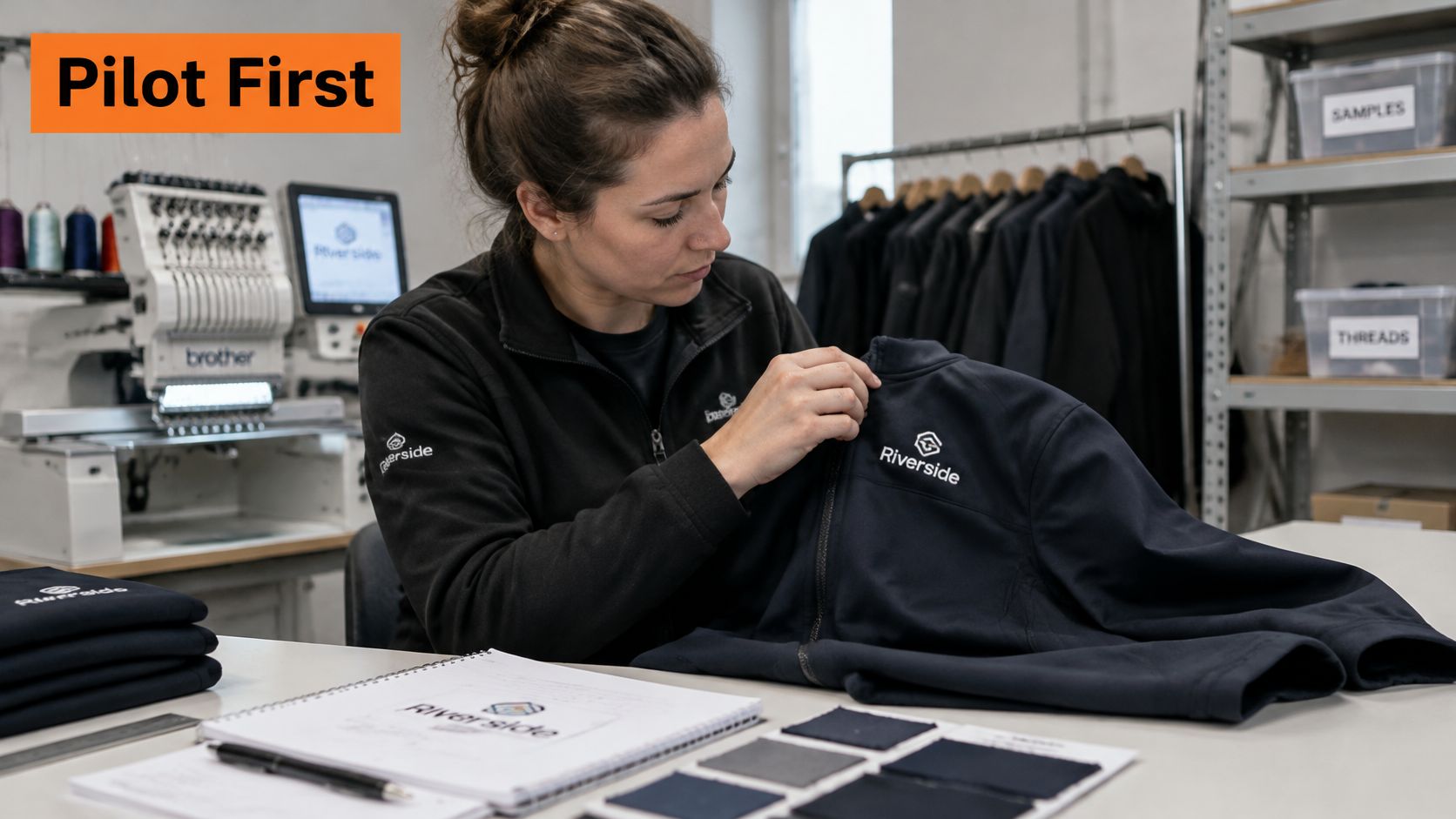
The pilot is the step most likely to prevent a costly reorder. A digital proof can show spelling and approximate position, but it can't reveal how the needlework behaves on the chosen fabric.
Inspect the sewn result before washing
Have the decorator digitise the artwork with fabric-appropriate underlay, then sew it onto the actual garment. A swatch is useful for colour selection, but it doesn't reproduce the tension around a pocket, zip or shaped panel.
Use a flat surface and good light for inspection:
- Fabric condition: Look for puckering, needle damage and distortion around the design.
- Stitch formation: Check thread breaks, loose loops, skipped stitches and uneven coverage.
- Inside finish: Inspect exposed backing, rough corners and loose ends against the wearer's skin.
- Usability: Confirm that pockets open and the decoration doesn't obstruct labels or identification.
Wash and dry the pilot using the intended care process. Record garment dimensions beforehand, then check distortion, colour loss, edge movement and the feel of the backing afterwards.
Keep the approved garment labelled with its fabric, thread, backing and artwork version. Don't let production proceed against an unwashed replacement sample just because it looks cleaner.
Define what the delivery promise includes
Ask for production time from pilot approval to dispatch, not an ambiguous estimate from the first enquiry. Establish whether sample production, artwork changes and garment sourcing sit inside or outside that period.
Confirm the minimum order per design and colour, digitising charges, sample costs and how later name changes are charged. Ask whether the stitch file can be reused for reorders and whether a different garment requires fresh sampling.
Paying for faster freight won't recover time lost waiting for artwork approval or unavailable base garments.
If rush production is offered, ask which checks remain in place. Don't trade away the wash test to meet a date that should have been negotiated before purchasing.
Finally, agree how faulty garments will be handled and who authorises replacements. Build receiving inspection into the schedule, with the approved pilot available to the person checking the shipment.
Caring for Embroidered Work Clothes and When to Replace Them
Start with the garment's care label. Following it helps protect the fabric and embroidery; check separately whether the garment is suitable for industrial laundering. For ordinary crew garments where the label allows, wash cold and inside out with similar colours. Avoid bleach and tumble drying, and keep the iron off the decoration.
Replacement matrix for embroidered work clothes
| Garment type | Remove from service when | Action |
|---|---|---|
| Standard cotton or heavyweight tee | Logo lifts or frays, or fit no longer suits the wearer | Withdraw; replace on reorder cycle |
| Heavyweight hoodie | Logo lifts, snag points form, or fit no longer suits the wearer | Replace; keep as identity layer only |
| Certified high-visibility D, N or D/N garment | Reflective tape peels or high-visibility colour fades | Remove immediately; replace with a conforming garment |
| Cap | Logo lifts or front panel frays | Withdraw; replace on reorder cycle |
| Insulated crib bag | Stitching near seams, zips or handle anchors frays | Replace; check seam integrity and handle security before reuse |
Alsco's guidance on uniform compliance discusses maintaining uniforms and replacing them when they no longer meet workplace requirements. Use that as a prompt to make care and withdrawal part of the garment's service-life plan.
Record issue dates and why garments are withdrawn. Use that history to plan reorders and identify recurring failures before repeating the same specification. A decoration that remains intact does not make a garment fit for service if its visibility or structural condition has deteriorated.
Confirm the Spec Before You Approve the Order
Sign off the spec before bulk payment, so the decorator is not resolving safety and fit questions during production. Keep three final checks distinct from the garment, artwork and sample approvals: confirm the commercial terms, assign responsibility for receiving inspection, and separate PPE compliance from decorative branding.
- Commercial terms: Record minimums, charges, the production trigger and dispatch expectations.
- Receiving inspection: Name the person responsible for checking the first run before garments are issued.
- PPE compliance: Keep approval of regulated PPE separate from acceptance of decorative crew layers. Branded appearance does not replace conformity documentation.
Outrig Supply Co is based in Perth and serves crane, rigging, FIFO and shutdown crews, including through crew bulk-order enquiries. Send your supplier the completed sign-off, marked garment layout and measurement sheet, then request a written quote and pilot sample before committing to bulk production.
At Outrig Supply Co, we offer heavyweight tees and hoodies for crane crews, riggers, shutdown workers and FIFO workers, alongside headwear, crib gear and drinkware. Visit our store to organise your crew gear, and bring your garment requirements and measured size list to a bulk-order enquiry so you can establish what's suitable before approving decoration.