

You know the scene. It's 4.45am, the cab's cold, the sun hasn't lifted, and you're pulling on a jumper that's either cut for a bloke's shoulders or hangs off you like it was never meant for site work. On WA jobs, that's not a small annoyance, it changes how you climb, reach, crouch and layer under hi-vis when the day turns from freezing pre-dawn to hard sun by lunch.
A work jumper womens range only works if it handles that shift properly. Fit, fabric and layering aren't style details, they're the difference between a layer you trust and one you keep fiddling with all day.
Table of Contents
- Why Womens Work Jumpers Are a Safety Issue, Not Just Style
- Understanding Fabric Choices for Australian Site Conditions
- Getting the Right Fit With Multi-Point Sizing
- Layering a Work Jumper Across Australian Conditions
- Styling and Fit for Crane, Rigging and FIFO Roles
- Building a Workwear Rotation That Lasts the Shift and the Wash
- Your Work Jumper Buying Checklist
Why Womens Work Jumpers Are a Safety Issue, Not Just Style
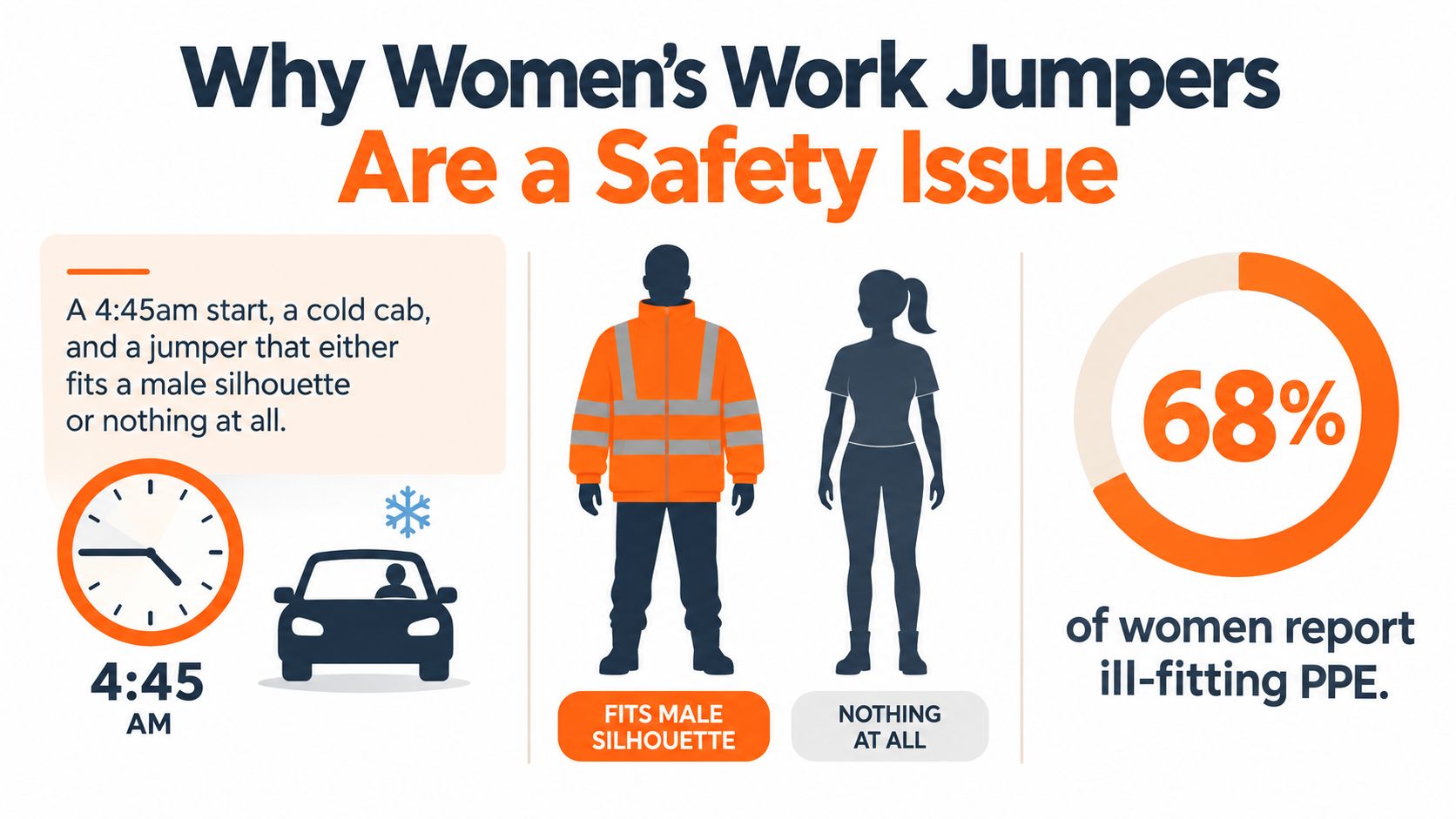
A cold cab before sunrise tells you more about workwear than any catalogue shot. If the jumper rides up when you lift your arms, pulls across the bust when you crouch, or bunches under a harness and hi-vis, it stops behaving like a layer and starts behaving like a distraction.
Fit changes how a shift feels
Australian tradie research found that almost half of female tradies wore casual or non-safety clothing because there were limited options, 40% felt less safe in ill-fitting garments, 33% said they couldn't work as hard as they wanted to, and 20% felt they didn't belong when they wore the wrong clothing. That isn't a vanity issue, it's a workability issue, and it lines up with what site crews already know, bad fit costs energy.
Practical rule: if you're adjusting your jumper every few minutes, it's not supporting the job you're doing.
Women are still a very small share of the Australian trade workforce, and an industry article citing Tradeswomen Australia said women represented only 2% of the workforce while Australia faced shortages across 65 trade areas. That imbalance matters because more women are entering crane, rigging, FIFO and shutdown roles, and those roles need layers cut for movement, not just smaller versions of menswear. The market signal is straightforward, fit-for-purpose women's site layers matter because the workforce base is growing from a very low starting point. Australian trade workforce and women's participation
Belonging shows up in the way gear fits
A woman on site notices fast whether a jumper was made with her body in mind. If the shoulders sit right, the hem stays put, and the sleeves don't swallow her hands, she looks like part of the crew instead of someone borrowed from another department.
That matters in crane cabins, on shutdown decks and in FIFO compounds where crew identity is visible. The wrong cut can make a worker hesitant to move hard, and hesitation is exactly what you don't want when the task calls for climbing, lifting or working around gear.
Understanding Fabric Choices for Australian Site Conditions
Pre-dawn starts, hot afternoons and air-conditioned site vehicles can all fall within one shift. A women's work jumper needs to handle heat, sweat, sun, wind and repeated washing, so fabric choice affects how well the layer performs across changing conditions.
Cotton earns its place in heat
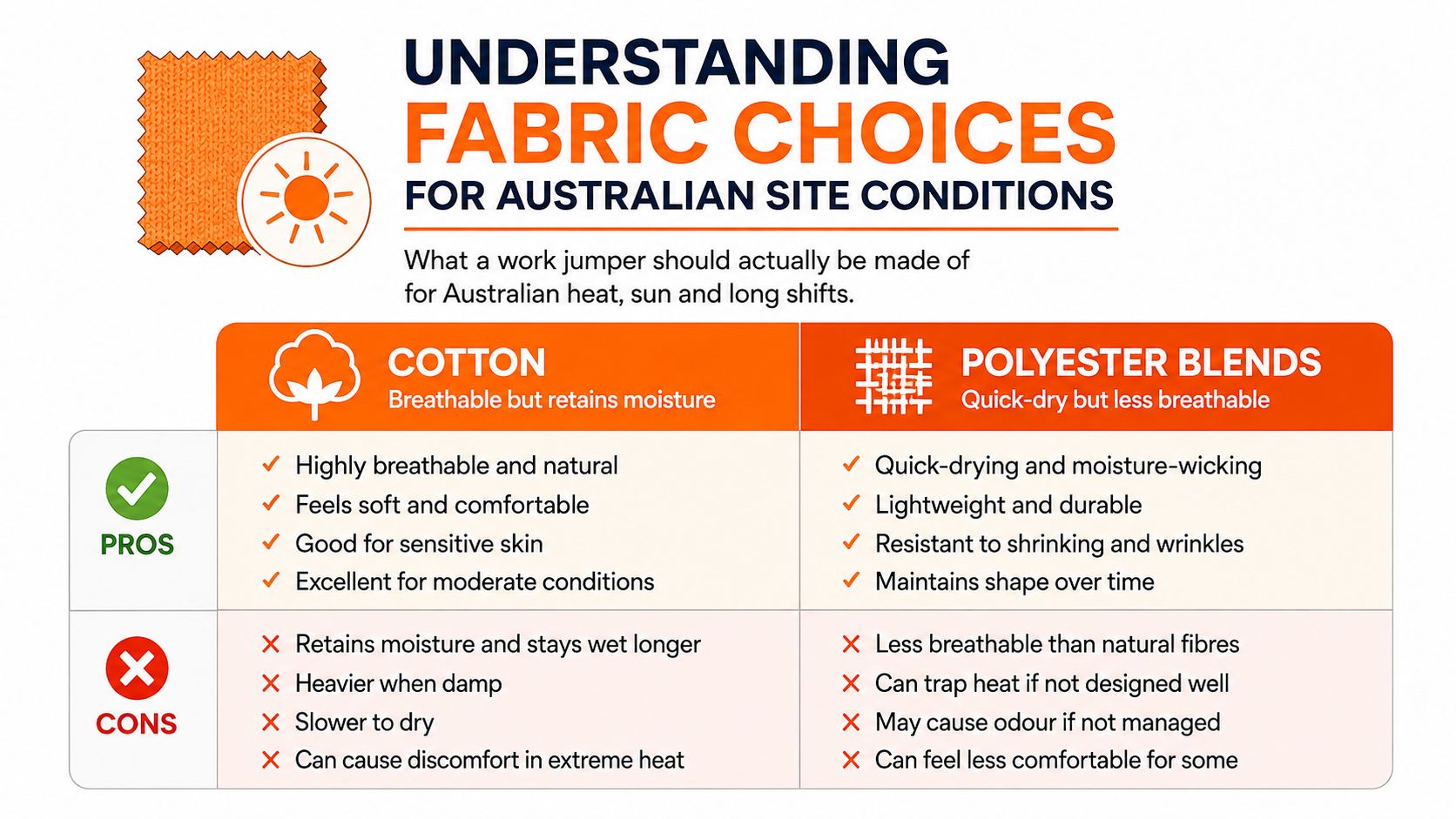
Australian workwear guidance notes that cotton drill can outperform polyester blends in summer heat because natural fibres allow more airflow and moisture evaporation. That helps reduce heat build-up during long shifts in direct sun. On WA sites, the practical trade-off is clear: if the work is physical and the day is hot, breathability usually matters more than a heavy feel. Australian workwear size and fabric guidance
Heavyweight cotton still earns a place in the rotation. It suits cold camp mornings, windy shutdown yards and travel between work areas, where a dense layer feels steadier than a thin throw-on. It also holds its shape better after being stuffed into a ute or pushed into a crib bag. For weight, weave and fit considerations, see this heavyweight T-shirt fabric weight and fit guide.
Blends are useful, but only in the right lane
Polyester blends work well when quick drying matters more than airflow. They suit workers moving between washed, packed and worn again with limited drying time. In harsh sun, however, synthetic fibres can hold more heat than cotton, so they need to be matched to the task and conditions.
The Outrig Offshore Crew Hoodie provides a practical example from the heavier end of the market. Its heavyweight fleece base is intended for cold starts, night runs, travel days and crew transfers beyond the shoreline. That construction offers warmth and structure, while giving up some summer breathability.
Choose the jumper for the shift, not just the coldest hour. A layer that feels comfortable at 5am can become restrictive and too warm by 9am, especially under hi-vis or inside an air-conditioned vehicle.
Breathable does not mean flimsy, and heavyweight does not suit every month of the year.
Getting the Right Fit With Multi-Point Sizing
Unisex chest sizing hides a lot of problems for women. A jumper can look close on paper and still pull across the bust, gap at the hem or restrict the reach you need to climb into a cab or work around gear.
Multi-point measurements reduce guesswork
Women's work jumpers sold in Australia are commonly sized with bust, waist, lower-waist, hip and in-leg measurements rather than one flat chest number. One AU workwear chart maps women's jumper sizes 6–24 to bust measurements from 80 cm to 125 cm in 5 cm increments, which helps reduce fit error because body shape variation is captured across more than one girth. AU workwear size chart guide
| Women's Work Jumper Size Chart at a Glance | ||
|---|---|---|
| Size | Bust (cm) | Fit note for layering |
| 6 | 80 | Snug if worn over a base layer only |
| 8 | 85 | Close fit, check shoulder reach |
| 10 | 90 | Good for light layering |
| 12 | 95 | Safer choice if you wear it over hi-vis |
| 14 | 100 | Relaxed site fit for cooler starts |
| 16 | 105 | Better when you want room through the torso |
| 18 | 110 | Useful for broader shoulders or thicker layers |
| 20 | 115 | Works when comfort and layering matter most |
| 22 | 120 | Check sleeve length and hem control |
| 24 | 125 | Best checked against movement, not just size |
The measuring step is simple. Take bust, waist and hip measurements at home, then compare those to the chart, not just the label. After that, decide whether you want a true-to-size relaxed fit or a size up for room over hi-vis and a base layer.
Movement beats mirror fit
A mirror won't tell you whether the jumper works when you crouch to rig gear, reach overhead in a cabin or climb onto plant. Try the reach test, the crouch test and the twist test before you commit.
Site fit test: if it binds when you reach forward and pulls when you sit, it's too small for work, even if it looks fine standing still.
The practical detail people miss is that a women's jumper should be measured against the way your body moves on site, not against a hanger. If you want a step-by-step approach, the measurement notes in how to measure yourself for workwear when ordering online are worth using before you order.
Layering a Work Jumper Across Australian Conditions
A good jumper acts like a tool in a kit, not a single tool that has to do everything. On an Australian site day, you can start in the dark, sit in air-con, step into wind off the water, then strip layers before lunch if the heat kicks in.
Build the system from the inside out
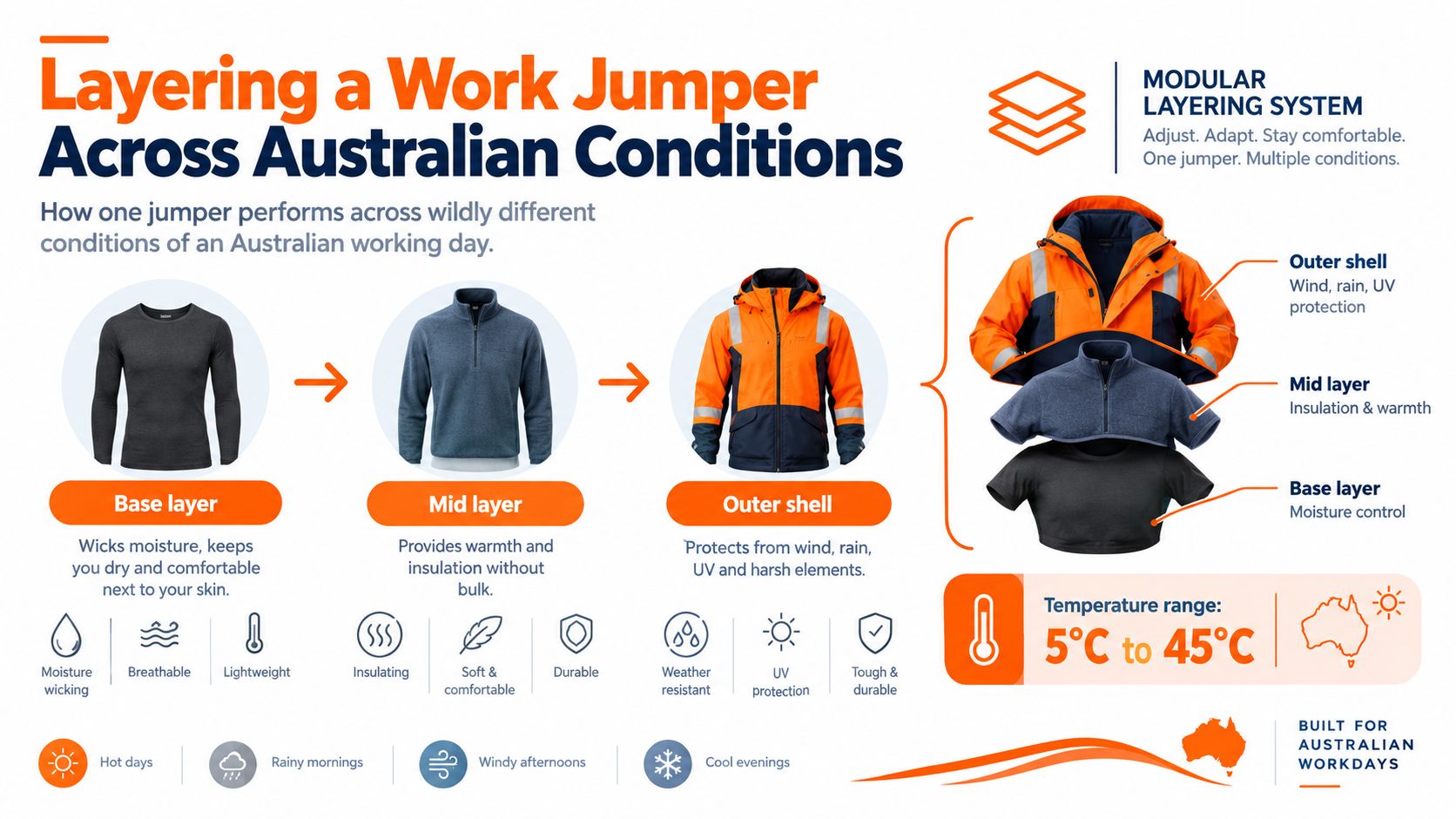
Start with a base layer that moves sweat off the skin. Add a jumper that gives you warmth without locking up your shoulders. Finish with hi-vis or an outer shell that still lets you move, bend and work around tools.
For a cool pre-dawn start, a heavier jumper makes sense because the air is cold and the body hasn't warmed up yet. Once you're in an air-conditioned site vehicle or crane cabin, the same jumper can become too warm if it's oversized or made from a fabric that traps heat. On windy coastal shutdowns, the wind proofing of the outer layer matters as much as the jumper underneath.
Match the jumper to the worst part of the day
The mistake I see most often is buying for the coldest ten minutes and ignoring the next ten hours. That's how you end up with a thick layer you regret by mid-morning or a light layer that never earns its keep on a winter swing.
A better approach is to judge the jumper on layering compatibility, fabric recovery and breathability. If it can sit under hi-vis without bunching, spring back after a wash and still let heat out when the sun hits, it's doing its job.
The workwear market is moving toward lighter, durable, moisture-wicking pieces that can transition between field and office use, and that shift makes sense on mixed Australian sites. Uniform is already a common dress code in the workforce, so functional layering is a productivity issue, not a style extra. Australian workplace dress norms and work attire data
Styling and Fit for Crane, Rigging and FIFO Roles
A crane operator, rigger and FIFO hand don't need the same jumper details, even if they all work under the same sun. The garment has to suit the job shape, and the job shape changes with the role.
Details that matter on site
Cuffs matter when you're working around controls, climbing or handling gear because loose sleeves get in the way fast. Hems matter because a short-cut jumper rides up under hi-vis and a long one can catch when you're bending or sitting in a cab.
Hoods are useful on travel days and cold starts, but they need to sit cleanly under site rules and hard hats. Kangaroo pockets help with gloves, crib cards and small bits you don't want disappearing in the ute.
The cut itself should make a woman look like she belongs in the crew without forcing a boxy mens silhouette onto her frame. That's where trade-specific ranges start to make sense, because they're shaped around the work rather than an office wardrobe.
Look for crew logic, not generic merch logic
The Outrig Supply Co Pink Hook Hoodie is a useful example because it's a heavyweight cotton pullover hoodie sized XS–5XL, printed to order in Australia, and it runs true to size in a relaxed fit, with advice to size down for a closer fit or stay true or size up for room to layer. That kind of fit note is practical because it tells you how the garment behaves on body, not just what size tag is sewn in. Pink Hook Hoodie product page
For role-specific context, the crane and rigging gear notes at what the crew actually wears on Australian worksites are useful because they frame apparel as part of the daily job, not as merch. That mindset is what you want when you're choosing a jumper for shutdowns, travel days and uneven site conditions.
Building a Workwear Rotation That Lasts the Shift and the Wash
One jumper rarely does enough on its own. FIFO swings, shutdown blocks and back-to-back 12-hour days mean your rotation has to survive sweat, dust, pack-down and whatever laundry access you've got on the swing.
Rotation beats single-item thinking
A practical rotation usually means at least one heavier jumper for cold starts, one lighter layer for variable days and one backup that can go straight back in the bag after a wash. That way you're not gambling on a single garment getting through an entire week without turning soft, stretched or misshapen.
Heavyweight cotton tends to hold its shape better than flimsy fleece when it's worn hard and washed often. That matters more than new-look softness, because a jumper that keeps its structure after repeated use feels better under hi-vis and doesn't start looking tired halfway through a swing.
Keep the care simple
Wash it cold, turn it inside out and dry it in the shade when you can. That's enough for most site jumpers, and it helps preserve cuffs, hems and printed surfaces without special treatment.
If you're outfitting a crew, consistency matters too. Matching the women's range with the rest of the team keeps the site look coherent and makes bulk ordering easier for supervisors who need gear that arrives as a set rather than a pile of mismatched layers.
A workwear rotation should be boring in the best way, the same reliable gear, washed, packed and ready again.
Your Work Jumper Buying Checklist
Buy the jumper against the shift, not against the mirror. If it passes the movement test, layers cleanly under hi-vis and suits the season you're buying for, you're on the right track.
- Check the sizing method: Look for bust, waist and hip measurements, not just a unisex chest size.
- Test the movement: Reach, crouch and twist before you decide.
- Match the fabric to the weather: Cotton drill for hot, dry sun exposure, heavier cotton for cold starts and travel days.
- Think about layering: Make sure it fits over a base layer and under hi-vis without bulk.
- Check the details: Cuffs, hems, pockets and hood shape should suit your actual tasks.
- Avoid one-jumper thinking: A single heavy fleece won't suit every Australian condition.
- Treat fit as workwear, not style: If it restricts movement or makes you keep adjusting it, leave it behind.
The strongest work jumper choices are the ones that support the job, the climate and your body at the same time. That's what makes fit-for-purpose women's workwear worth buying, and it's why more trade-run brands are building ranges with site conditions in mind.
If you want gear that speaks the language of crane cabins, shutdown yards and long swings, take a look at Outrig Supply Co. The range includes worksite apparel and crew gear built around trade use, with options that suit women in the same hard conditions everyone else is working through.